Use case: YouTube and AdSense
YouTube tax form for non-U.S. creators: completing Google's W-8BEN in AdSense
Google's “U.S. tax info” tool is Form W-8BEN in a different outfit. This guide maps every screen to the form, shows the treaty rate for your country, and explains what Google withholds if you skip it.
If you earn money from YouTube and live outside the United States, Google asks you to “submit your U.S. tax info” in AdSense. YouTube’s help centre states that all monetizing creators, wherever they live, are required to provide it. The tool never uses the words on its first screen, but for a non-U.S. individual it produces Form W-8BEN, the IRS certificate of foreign status. Answer it well and Google withholds only a treaty rate on the slice of your revenue that comes from U.S. viewers. Skip it and Google may take 24% of everything you earn, worldwide.
This guide walks through that tool screen by screen, shows which line of the official form each question feeds, gives the treaty rate for your country, and lists the reasons Google puts a submission “under review”. It is educational information, not tax advice.
What Google withholds, and from which earnings
Google withholds U.S. tax under Chapter 3 of the Internal Revenue Code. The figures below are quoted from YouTube’s help pages on U.S. tax requirements.
| Comparison | No tax info submitted | W-8BEN, no treaty | W-8BEN with a treaty claim |
|---|---|---|---|
| Rate | 24% (individual accounts) | 30% | 0% to 30%, depending on the treaty |
| Applied to | Total earnings worldwide | U.S. earnings only | U.S. earnings only |
| Example: $1,000 total, $100 from U.S. viewers | $240 withheld | $30 withheld | $0 (UK, 0%) or $15 (India, 15%) |
| Year-end statement | Form 1042-S | Form 1042-S | Form 1042-S |
Two details matter more than the headline rates.
- Only U.S.-viewer revenue is taxable once a valid form is on file. YouTube lists the revenue types that count: ad views, YouTube Premium, Super Chat, Super Stickers, Super Thanks, and channel memberships, in each case from viewers in the United States. Revenue from viewers elsewhere is not subject to U.S. withholding.
- The penalty for silence is worldwide. For an individual account with no tax info, YouTube says “backup withholding will apply and 24% of total earnings worldwide will be withheld”. A non-U.S. business account with no form is instead withheld at 30% of U.S. earnings. That is why a creator in a country with no treaty at all still gains from filing: 30% of the U.S. slice is far less than 24% of everything.
YouTube’s own example is an India-based creator earning $1,000 in a month, $100 of it from U.S. viewers. With a valid W-8BEN claiming the India treaty, the withholding is 15% of $100, so $15.
Where the form lives in AdSense
YouTube’s help centre gives this path, which is the same in AdSense for YouTube and in a regular AdSense account:
- Sign in to AdSense.
- Open Payments, then Payments info.
- Click Manage settings.
- Scroll to Payments profile and click the edit icon next to United States tax info.
- Click Manage tax info.
Once you submit, the status shows In review for up to 7 business days according to Google, then Approved or Declined. Google asks for the form by December 10 each year so that it applies before year-end statements are produced.
Before you open the tool
Gather these first. Google’s tool times out and does not save partial answers.
- Your legal name exactly as it appears on your identity documents. Google compares it with the name on your payments profile, and a mismatch is the most common reason a W-8 goes under review. If you use a creator name, it does not belong in the legal-name field.
- A permanent residence address in the country whose treaty you will claim. Google rejects PO boxes and “in care of” addresses for this field, and a U.S. address on a W-8 triggers a request for supporting documents.
- Your foreign tax identification number. Google states that “if you are claiming a tax treaty benefit, you are required to provide either a Foreign TIN or a U.S. TIN”. Its examples include India’s PAN, Indonesia’s NPWP, Japan’s My Number, and the UK’s UTR or National Insurance number. You do not need a U.S. SSN or ITIN.
- Plain Latin characters. The tool accepts only a–z, A–Z, 0–9, spaces, hyphens, and ampersands. Write “Muller” for “Müller” and “Sao Paulo” for “São Paulo”.
- Your treaty rate and article. Use the table further down this page. The tool identifies your treaty automatically when you pick a country, but knowing the expected rate lets you spot a wrong selection before you sign.
Prepare and review your answers in our tool
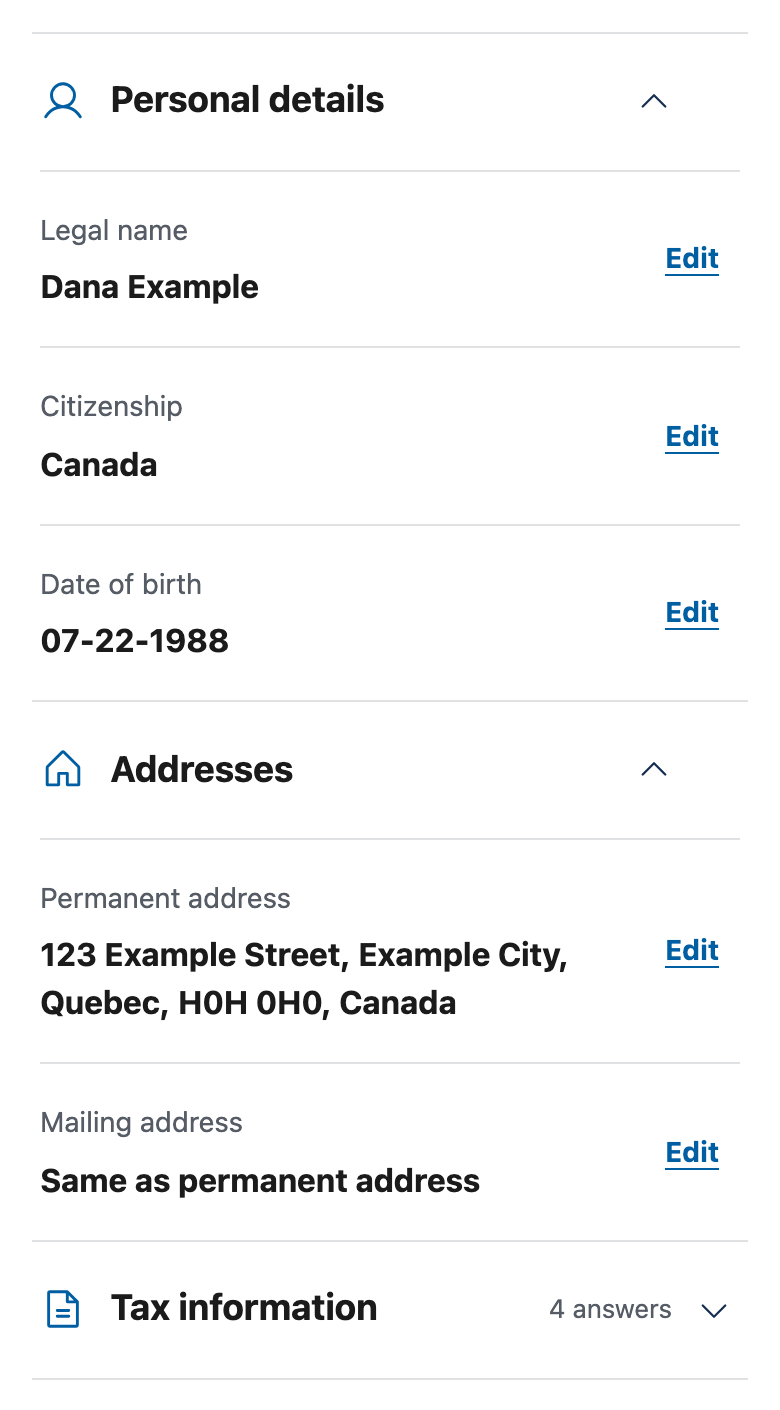
The answer-review panel in our W-8BEN interview, using the fictional Dana Example fixture. This is our preparation tool; a payer’s tax portal has its own screens and submission process.
Open full-size screenshotOpen full-size screenshot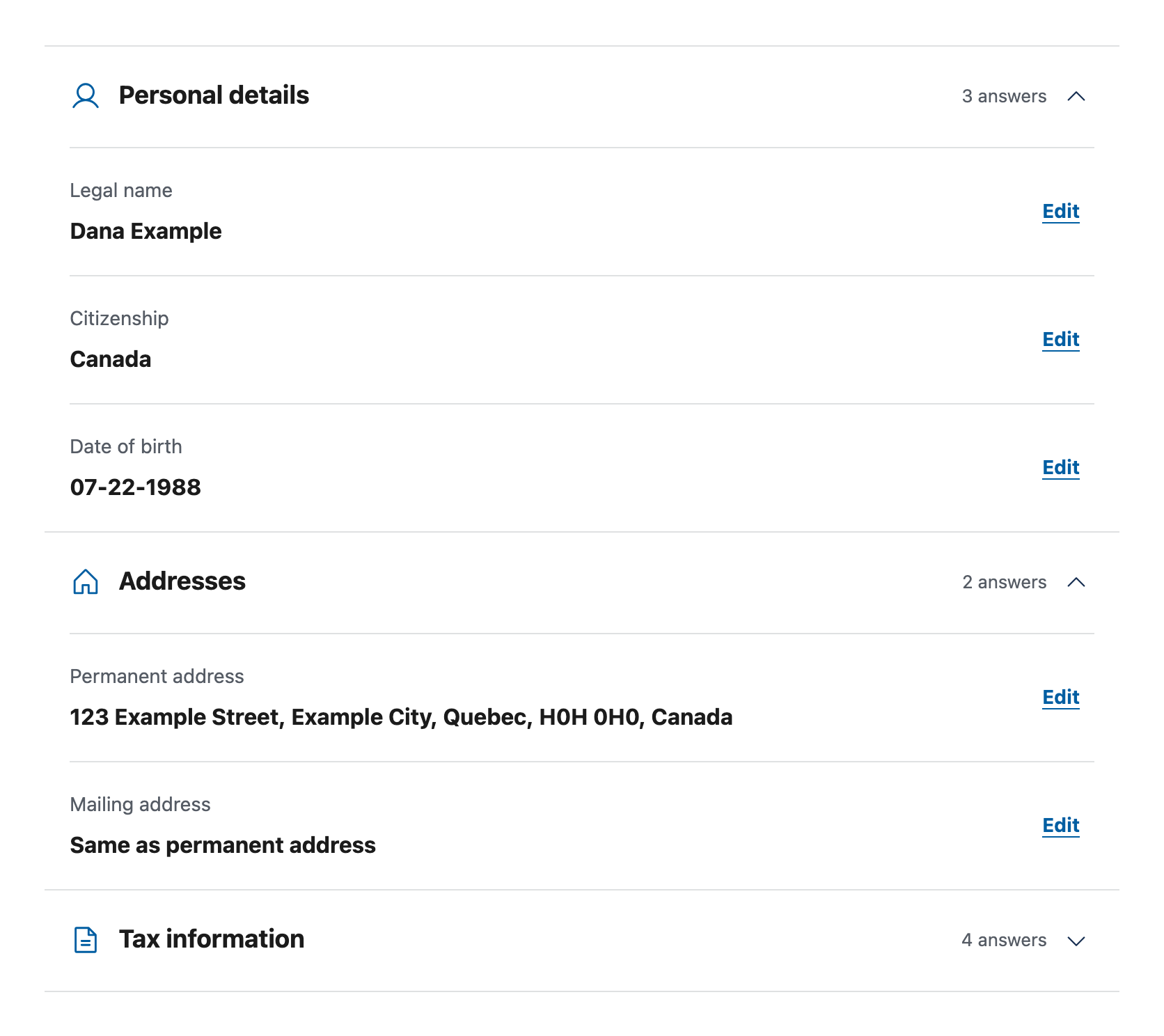
- Review the answers in each section
Check Personal details and Addresses, then expand Tax information to review the remaining answers.
Back to screenshot - Use Edit to correct an answer
Each Edit button returns to that question so you can correct it before continuing. Completing and reviewing the answers is free; signing and downloading come after payment.
Back to screenshot
Google’s questions, mapped to Form W-8BEN
Google generates the IRS form from your answers and shows you the PDF to confirm before you sign. This table tells you where each answer lands, so you can check the preview against the official form.
| Screen in Google’s tax tool | What it becomes | What to enter |
|---|---|---|
| Account type: Individual or Non-individual/entity | Chooses W-8BEN (individual) or W-8BEN-E (entity) | An individual account is “owned and operated by an individual person and not a legal organization”. Pick entity only if a company, not you, is the payee. |
| Are you a citizen or resident of the United States? | “Yes” switches to Form W-9 | Non-U.S. creators answer no. Dual citizens and green-card holders are U.S. persons and should not file a W-8. |
| Legal name | W-8BEN Line 1 | Exactly as on your passport or national ID and on your AdSense payments profile. |
| Country of citizenship | W-8BEN Line 2 | Your citizenship, which may differ from your treaty country. |
| Permanent residence address | W-8BEN Line 3 | A street address in the country where you are tax resident. No PO box, no “c/o”. |
| Mailing address (if different) | W-8BEN Line 4 | Optional. Leave blank if it is the same. |
| U.S. taxpayer identification number | W-8BEN Line 5 | Optional. Most creators leave it blank. |
| Foreign tax identification number | W-8BEN Line 6a | Your home-country tax number. Required if you claim a treaty. |
| Date of birth | W-8BEN Line 8 | Required for individuals. |
| Tax treaty: are you claiming a reduced rate? | W-8BEN Line 9 (country) | Yes, if your country appears in the table below with a rate under 30%. |
| Payment types: Other Copyright Royalties, Motion Picture & TV Royalties, Services | W-8BEN Line 10 (article, rate, income type) | YouTube Partner Program revenue is “Other Copyright Royalties”. Google says to select every type you are eligible for. AdSense on a website is “Services”. |
| Document preview | The generated Form W-8BEN PDF | Check the name, address, TIN, and the treaty article against this guide before continuing. |
| Certification and signature | W-8BEN Part III | Type your legal name. Leave the Capacity field empty when you sign for yourself; Google flags a filled capacity field for review. |
| Activities and services performed in the U.S. | Not on W-8BEN | Google defines U.S. activities as “the performance of a service in the United States”. Most creators answer no. A yes can mean a different form (W-8ECI). |
| Affidavit of unchanged circumstances | Not on W-8BEN | Only relevant when you are replacing an earlier form. It lets Google apply the new rate to earlier payments in the same year. |
Two choices deserve a closer look.
The payment-type screen
Google’s help centre describes three treaty categories: Other Copyright Royalties “such as Play and YouTube Partner Program”, Motion Picture & TV Royalties “such as certain YouTube Movies and Shows and Play partners”, and Services “such as AdSense”. On the official form these become Line 10, where you cite a treaty article and rate for a type of income.
Ordinary channel revenue is copyright royalties. If you also earn from AdSense on a website, tick Services as well. Google withholds “at the appropriate rate based on the income type being paid” and ignores any category you tick but never get paid for, so ticking every category you could plausibly receive is safe. The rate for copyright royalties is the one that matters for almost every creator, and that is the column the selector below leads with.
Individual or entity
If your channel’s payee is a limited company, an LLC outside the U.S., or any other organization that is separate from you for tax purposes, choose the entity path. It produces Form W-8BEN-E, which has different questions about the entity’s classification and its limitation-on-benefits status. Our W-8BEN-E interview handles that form. Creators paid through a multi-channel network follow YouTube’s separate page for MCNs and affiliate channels, linked in the sources.
Treaty rate for your country
Select your country of tax residence. The result shows the withholding rate the IRS treaty table lists for copyright royalties, the film-and-TV rate for comparison, and the treaty article you would expect to see cited on Line 10 of the generated form.
Withholding rates on U.S.-source royalties by treaty country
Transcribed from IRS Tax Treaty Table 1, columns for film and television royalties (income code 11) and copyright royalties (income code 12).
Your selection stays in this browser tab and is not sent anywhere.
Show the full table for every treaty country
| Country | Copyright royalties | Film and TV royalties | Treaty article |
|---|---|---|---|
| Armenia | 0% | 0% | III(1)(a) (U.S.–U.S.S.R. treaty) |
| Australia | 5% | 5% | 12(2) / P8 |
| Austria | 0% | 10% | 12(1), (2) |
| Azerbaijan | 0% | 0% | III(1)(a) (U.S.–U.S.S.R. treaty) |
| Bangladesh | 10% | 10% | 12(2) |
| Barbados | 5% | 5% | 12(2) / 1PV; 2PII(6) No treaty benefit if the recipient is under a special low-tax regime (Table 1 footnote rr). |
| Belarus | 30% | 30% | Treaty partially suspended The IRS lists the U.S.–U.S.S.R. treaty as partially suspended for Belarus. Treat the rate as 30% unless a tax adviser confirms otherwise. |
| Belgium | 0% | 0% | 12(1) |
| Bulgaria | 5% | 5% | 12(2) / P5(7) |
| Canada | 0% | 10% | XII(2), (3) / 5P7(1) |
| Chile | 10% | 10% | 12(1)–(6) |
| China | 10% | 10% | 11(2) |
| Cyprus | 0% | 0% | 14(1) |
| Czech Republic | 0% | 0% | 12(2) |
| Denmark | 0% | 0% | 12(1) |
| Egypt | 15% | Not covered by the royalty article | 13(1) |
| Estonia | 10% | 10% | 12(2) |
| Finland | 0% | 0% | 12(1) |
| France | 0% | 0% | 12(1) / 2PIII |
| Georgia | 0% | 0% | III(1)(a) (U.S.–U.S.S.R. treaty) |
| Germany | 0% | 0% | 12(1) |
| Greece | 0% | 30% | VII |
| Hungary | 30% | 30% | Treaty terminated The IRS lists the U.S.–Hungary treaty as terminated. The statutory 30% rate applies. |
| Iceland | 0% | 5% | 12(1), (2) |
| India | 15% | 15% | 12(2)–(4) |
| Indonesia | 10% | 10% | 13(2) / P34 |
| Ireland | 0% | 0% | 12(1) |
| Israel | 10% | 10% | 14(1) |
| Italy | 0% | 8% | 12(2) Italy taxes software royalties at the industrial-equipment rate rather than the copyright rate (Table 1 footnote tt). |
| Jamaica | 10% | 10% | 12(2) |
| Japan | 0% | 0% | 12(1) |
| Kazakhstan | 10% | 10% | 12(2) |
| Kyrgyzstan | 0% | 0% | III(1)(a) (U.S.–U.S.S.R. treaty) |
| Latvia | 10% | 10% | 12(2) |
| Lithuania | 10% | 10% | 12(2) |
| Luxembourg | 0% | 0% | 13(1) |
| Malta | 10% | 10% | 12(2) |
| Mexico | 10% | 10% | 12(2) |
| Moldova | 0% | 0% | III(1)(a) (U.S.–U.S.S.R. treaty) |
| Morocco | 10% | 10% | 12(2) |
| Netherlands | 0% | 0% | 13(1) |
| New Zealand | 5% | 5% | 12(2) / PVIII |
| Norway | 0% | Not covered by the royalty article | 10(1) |
| Pakistan | 0% | Not covered by the royalty article | VIII(1) Payments for TV broadcasting rights fall under the royalty article, but rental income from motion picture films does not (Table 1 footnote u). |
| Philippines | 15% | 15% | 13(2) The Philippine domestic rate differs from the U.S. treaty rate (Table 1 footnote vv). |
| Poland | 10% | 10% | 13(2) |
| Portugal | 10% | 10% | 13(2) |
| Romania | 10% | 10% | 12(2) |
| Russia | 30% | 30% | Treaty partially suspended The IRS lists the U.S.–Russia treaty as partially suspended, and the suspension covers the royalties article. Treat the rate as 30%. |
| Slovak Republic | 0% | 0% | 12(2) |
| Slovenia | 5% | 5% | 12(1) |
| South Africa | 0% | 0% | 12(1) |
| South Korea | 10% | 10% | 14(1) |
| Spain | 0% | 0% | 12(1) / PVI |
| Sri Lanka | 10% | 10% | 12(2) |
| Sweden | 0% | 0% | 12(1) |
| Switzerland | 0% | Not covered by the royalty article | 12(1) |
| Tajikistan | 0% | 0% | III(1)(a) (U.S.–U.S.S.R. treaty) |
| Thailand | 5% | 5% | 12(2) |
| Trinidad and Tobago | 0% | Not covered by the royalty article | 14(1) 15% for copyrights of scientific work (Table 1 footnote cc). |
| Tunisia | 15% | 15% | 12(2)–(3) |
| Turkey | 10% | 10% | 12(2) |
| Turkmenistan | 0% | 0% | III(1)(a) (U.S.–U.S.S.R. treaty) |
| Ukraine | 10% | 10% | 12(2) |
| United Kingdom | 0% | 0% | 12(1) |
| Uzbekistan | 0% | 0% | III(1)(a) (U.S.–U.S.S.R. treaty) |
| Venezuela | 10% | 10% | 12(2) |
| Any other country | 30% | 30% | No treaty. Common examples: Argentina, Brazil, Colombia, Ghana, Hong Kong, Kenya, Malaysia, Nigeria, Peru, Saudi Arabia, Singapore, Taiwan, United Arab Emirates, Vietnam. |
Read before relying on a rate: figures are transcribed from IRS Tax Treaty Table 1 (Rev. May 2023), columns for income codes 11 and 12. The table itself warns that it is not a complete statement of eligibility. Limitation-on-benefits rules, residence tests, and the payer's own review can change the outcome.
Three patterns in that table are worth knowing.
- Zero-rate countries. The United Kingdom, Ireland, Germany, France, Spain, the Netherlands, Belgium, Sweden, Denmark, Finland, Japan, South Africa, Canada (for copyright, not film), and several others reduce withholding on copyright royalties to 0%. A valid W-8BEN with a treaty claim means Google withholds nothing.
- Mid-rate countries. India and the Philippines are at 15%, Mexico, Portugal, Poland, South Korea, Turkey, Ukraine, and Israel at 10%, Australia, New Zealand, and Thailand at 5%.
- No treaty. Brazil, Argentina, Colombia, Nigeria, Kenya, Singapore, Hong Kong, Malaysia, the UAE, and Vietnam have no income tax treaty with the United States. Creators there file W-8BEN without a treaty claim and are withheld 30% of U.S.-viewer revenue, which still beats 24% of worldwide revenue. Hungary’s treaty has been terminated and Russia’s is partially suspended, so the IRS treats both as 30% for this purpose.
Why Google puts a W-8 “under review”, and what to send
Google’s AdSense FAQ lists the checks that send a W-8 form for manual review.
- The legal name or disregarded-entity name does not match the payments profile.
- The address is in the United States, or it is not in the country of the treaty claim.
- The permanent residence address is a PO box or an “in care of” address.
- The Capacity field in the signature section is filled in.
- The TIN is missing, is not nine digits where Google expects it, is not currently issued, or does not match the name on IRS records.
If Google asks for documents, it accepts PNG, JPEG, and PDF uploads. A form is Declined when the TIN cannot be found in IRS records, the TIN and name do not match, or the uploaded documents fail validation. Google’s instruction at that point is to “submit a new form or contact your tax adviser”. Fixing the name to match your payments profile, or correcting the address, resolves most declines.
How long the form lasts
Life of a W-8BEN submitted to Google
Google follows the IRS rule: the form stays valid until the end of the third full calendar year after the year it was signed, unless your circumstances change first.
You sign the form in Google's tax tool
Google reviews it within about 7 business days. Once approved, withholding on U.S.-viewer revenue drops to your treaty rate from the next payment cycle.
Your address, country, or name changes
The IRS instructions require a new form within 30 days of a change in circumstances. In Google's tool, submit a new form and, where relevant, the affidavit of unchanged circumstances for the period before the change.
December 10 each year
Google's deadline for submitting or updating tax info so it applies before year-end reporting. A form submitted after this date may not affect that year's Form 1042-S.
December 31, 2029
The form expires at the end of the third full calendar year after 2026. Google notifies you, and withholding reverts to the default rate if you do not resubmit.
Important: The example dates assume a signature in 2026 and no change in circumstances. A change in your country of residence or your legal name ends the form's validity early.
If withholding was applied at a higher rate earlier in the year, Google’s FAQ explains that an affidavit of unchanged circumstances submitted with a valid W-8 can support a refund of that year’s over-withholding, provided the claim is made by December 31 of the year in which the withholding occurred.
Worked examples
A creator in the United Kingdom earns $2,000 in a month, $400 of it from U.S. viewers. With W-8BEN and a UK treaty claim on copyright royalties, the rate is 0%, so nothing is withheld. Without any tax info, Google would withhold 24% of $2,000, which is $480.
A creator in Brazil earns the same $2,000 with $400 from U.S. viewers. Brazil has no treaty, so W-8BEN carries no treaty claim and Google withholds 30% of $400, which is $120. That is a quarter of the $480 they would lose by not filing at all.
A creator in India earns $1,000 with $100 from U.S. viewers. With the India treaty claim at 15%, Google withholds $15, which is YouTube’s own published example.
Frequently asked questions
Do I need a W-8BEN for YouTube if I have no U.S. viewers?
Yes. YouTube requires tax info from all monetizing creators. Without it, Google may apply 24% backup withholding to your worldwide earnings, regardless of where your viewers are. With a valid W-8BEN on file, only revenue from U.S. viewers is subject to withholding, so a channel with no U.S. audience is withheld nothing.
Do I need a U.S. tax number (SSN or ITIN) for the YouTube tax form?
No. Google states that a treaty claim requires either a foreign TIN or a U.S. TIN, and a foreign TIN from your own country is enough. Examples Google gives are India's PAN, Indonesia's NPWP, Japan's My Number, and the UK's UTR or National Insurance number.
Which payment type should a YouTuber select for treaty benefits?
YouTube Partner Program revenue is listed by Google under Other Copyright Royalties. If you also earn from AdSense on a website, select Services as well. Google advises selecting every income type you are eligible for and only applies each treaty claim when that type of income is actually paid.
Is the YouTube tax form the same as Form W-8BEN?
For a non-U.S. individual, yes. Google's tax tool collects the information on Form W-8BEN, generates the IRS PDF for you to preview, and stores your electronic signature. Non-U.S. companies get Form W-8BEN-E, and U.S. persons get Form W-9.
How long does Google take to approve tax info?
Google says a submission can stay in review for up to 7 business days. Forms that match the payments profile and carry a valid foreign TIN are often approved faster. Name mismatches, PO box addresses, and a filled-in Capacity field send the form for manual review.
My country has no tax treaty with the U.S. Should I still submit the form?
Yes. Without any tax info Google may withhold 24% of worldwide earnings for individual accounts. With a W-8BEN and no treaty claim, withholding is 30% but only on revenue from U.S. viewers, which is usually a much smaller amount.
When does the YouTube W-8BEN expire?
At the end of the third full calendar year after the year you signed it, unless a change in circumstances such as a new country of residence ends it earlier. A form signed in 2026 lasts until December 31, 2029. Google notifies you before expiry, and the IRS instructions require a new form within 30 days of a change.
I was withheld at 24% before submitting. Can I get it back?
Google's FAQ describes an affidavit of unchanged circumstances that, submitted with a valid W-8, allows the form to apply to earlier payment periods and can support a refund of that year's over-withholding. The claim must be made by December 31 of the year in which the withholding occurred. Amounts from earlier years are reported on Form 1042-S and may need a U.S. tax return to recover.