Use case: App and game developers
App Store, Google Play, Steam, and Roblox tax forms for non-U.S. developers: one W-8BEN, four portals
Every store asks the same IRS questions in a different order. This guide shows where each tax form lives, what each store withholds without one, and how to gather your W-8BEN answers once and reuse them in all four.
If you sell apps or games from outside the United States, every store you publish on will ask for a U.S. tax form before it pays you. App Store Connect calls it a tax form in the Agreements tab. Google Play calls it “United States tax info”. Steamworks calls it a tax questionnaire. Roblox calls it the DevEx Portal and, from November 2026, the Taxes page in Creator Hub. For a non-U.S. individual, all four produce the same document: Form W-8BEN, the IRS certificate of foreign status.
This guide explains why each store asks, where the form lives, and what each store withholds if you skip it. It then maps the interview questions to the lines of the official form. It is educational information, not tax advice.
Why every store asks for the same form
U.S. payers must document who they pay. When a U.S. company pays a foreign person income from U.S. sources, the IRS generally requires 30% withholding on royalties unless a treaty lowers the rate. The IRS instructions for Form W-8BEN list royalties among the income types subject to that withholding. Form W-8BEN is how you tell the payer two things: you are not a U.S. person, and, if your country has a treaty, which rate applies to you.
The four stores treat your income differently, and that changes what is at stake.
- Google Play, Steam, and Roblox classify developer payments as royalties. Google’s payments help tells Play partners to pick “Other Copyright Royalties”. Valve’s Taxes FAQ says “revenue share payments are classified as a royalty”. Roblox says DevEx payments “will be classified as royalties” from November 1, 2026. All three withhold on the U.S. share of your revenue without a valid form.
- Apple takes a different view. In a reply on its developer forums, Apple Finance wrote that “application sales by non-U.S. developers or publishers on the App Store or Book Store are not subject to U.S. tax withholding or reporting”, because the contract is “a sales/commission agreement, as opposed to a royalty agreement”. Apple still requires the form. Its help page states that “all developers must complete a US tax form to comply with the Paid Apps Agreement”.
So the form is the same everywhere, but the treaty claim matters most on Google Play, Steam, and Roblox.
The four portals side by side
| Comparison | Apple App Store | Google Play | Steam | Roblox DevEx |
|---|---|---|---|---|
| Where the form lives | App Store Connect: Business, then Agreements, then Tax Forms. Role: Account Holder, Admin, or Finance. | Play Console payments profile: Settings, then United States tax info, then Manage tax information. | Steamworks onboarding, after the distribution agreement and fee. Verified by a third party in 2 to 7 business days. | DevEx Portal run by Tipalti until October 31, 2026. From November 1, 2026, the Taxes page in Creator Hub. |
| Form produced for an individual | W-8BEN, after routing questions that can also lead to W-8BEN-E or W-8ECI. | W-8BEN, which Google's help calls the Certificate of Foreign Status. | Information "similar to that found on form W-8BEN", per the onboarding guide. | W-8BEN. Roblox generates W-9, W-8BEN, or W-8BEN-E from your answers. |
| Withholding without a form | None on app sales, per Apple Finance. Without the form you cannot complete the Paid Apps Agreement. | Generally 30% on U.S.-source payments. 24% backup withholding on all earnings if you are presumed a U.S. person. | 30% of the U.S. share of your revenue share payment. | 24% backup withholding on the whole payout from November 1, 2026. |
| Income type | Sales and commission, not royalties. | Other Copyright Royalties, on revenue from U.S. users only. | Royalty, on the portion derived from sales made in the U.S. | Royalties from November 1, 2026, on payments related to sales to U.S. players. |
| Year-end statement | None. Apple Finance says these sales are not subject to U.S. reporting. | Form 1042-S for non-U.S. payees. | Form 1042-S showing U.S.-source income and tax withheld. | Form 1042-S regardless of amount, from November 2026. |
Two details are easy to miss.
- Only the U.S. slice is taxed. Google’s help says “only the portion of your revenue earned from US users is subject to US withholding taxes and reporting”. Valve defines the “US Share” as “the portion of your payment that is derived from sales made in the US”. Roblox applies withholding to payments “related to sales to U.S. players”. Sales everywhere else are not withheld once a valid form is on file.
- Backup withholding hits everything. Roblox’s 24% backup withholding applies to the whole payout, not just the U.S. share. A developer with no treaty at all still gains by filing: 30% of the U.S. slice is almost always less than 24% of everything.
Before you open any of them
Gather once, enter four times. Each portal asks for the same facts, and each one will stall on the same mismatches.
- Your legal name exactly as on your passport and bank account. Steam says “the company name you enter must match the name as written on official documents with your bank”. Roblox says to make sure “the name in the DevEx portal matches the name on your bank account”. Your studio name, gamertag, or developer handle does not go in this field.
- A permanent residence address in your treaty country. The IRS instructions say not to use “a post office box, or an address used solely for mailing purposes”.
- Your foreign tax identification number. Valve says a treaty claim “requires either a foreign TIN or a US TIN”. Roblox says the same. Google asks for it as well. Your home-country number is enough. You do not need a U.S. SSN or ITIN for any of the four stores.
- Your date of birth, which Form W-8BEN requires for individuals.
- Your treaty rate and article. Use the selector further down. Knowing the expected rate lets you spot a wrong country selection before you sign.
- Which entity is the payee. If a company holds the developer account, you will be filing W-8BEN-E instead. See the section on studios below.
Prepare and review your answers in our tool
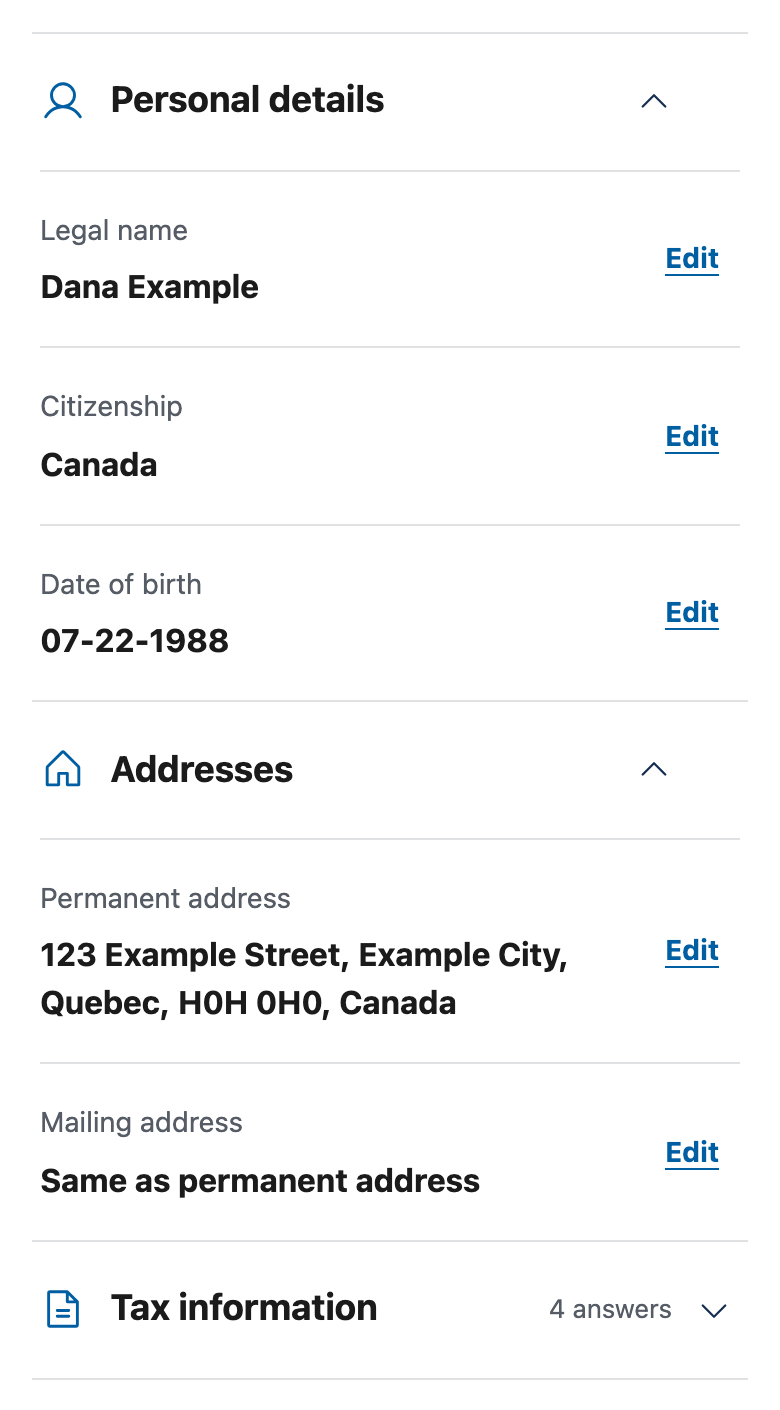
The answer-review panel in our W-8BEN interview, using the fictional Dana Example fixture. This is our preparation tool; a payer’s tax portal has its own screens and submission process.
Open full-size screenshotOpen full-size screenshot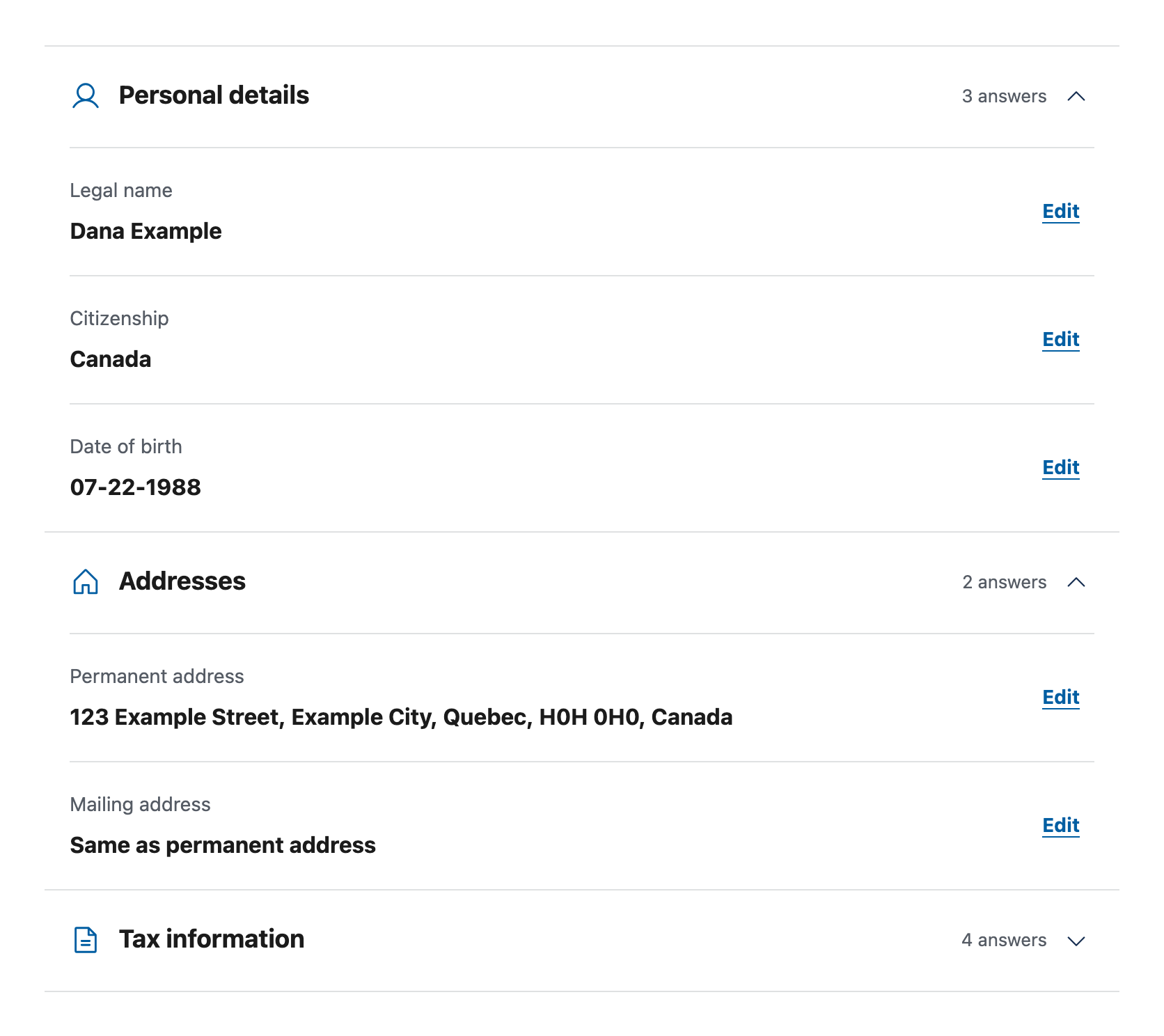
- Review the answers in each section
Check Personal details and Addresses, then expand Tax information to review the remaining answers.
Back to screenshot - Use Edit to correct an answer
Each Edit button returns to that question so you can correct it before continuing. Completing and reviewing the answers is free; signing and downloading come after payment.
Back to screenshot
The interview questions, mapped to Form W-8BEN
Each store phrases its questions its own way, but they all generate the IRS form from your answers. This table tells you where each answer lands, so you can check the preview each portal shows against the official form.
| Question as the stores ask it | What it becomes | What to enter |
|---|---|---|
| Individual or business? (Apple asks this as a series of routing questions; Google calls it account type; Roblox generates W-9, W-8BEN, or W-8BEN-E) | Chooses W-8BEN (individual) or W-8BEN-E (entity) | Individual only if you, personally, are the payee. A company account files W-8BEN-E. |
| Are you a U.S. citizen or resident? | “Yes” switches to Form W-9 | Non-U.S. developers answer no. Green-card holders and dual citizens are U.S. persons and do not file a W-8. |
| Name of individual | W-8BEN Line 1 | Exactly as on your passport, and matching the bank account each store pays. |
| Country of citizenship | W-8BEN Line 2 | Your citizenship, which may differ from your treaty country. |
| Permanent residence address | W-8BEN Line 3 | A street address in the country where you are tax resident. No PO box, no mailing-only address. |
| Mailing address, if different | W-8BEN Line 4 | Optional. Leave blank if it is the same. |
| U.S. taxpayer identification number (SSN or ITIN) | W-8BEN Line 5 | Optional. Apple Finance confirms it is not required to certify foreign status. Most developers leave it blank. |
| Foreign tax identifying number | W-8BEN Line 6a | Your home-country tax number. Required for a treaty claim on Google, Steam, and Roblox. |
| Date of birth | W-8BEN Line 8 | Required for individuals, in MM-DD-YYYY format on the IRS form. |
| Country of tax residence, or “claim treaty benefits?” | W-8BEN Line 9 | Your treaty country, if it appears in the table below with a rate under 30%. |
| Income type, treaty article, and rate (Google: “Other Copyright Royalties”; Steam and Roblox: royalty rate from your treaty) | W-8BEN Line 10 | The IRS says Line 10 is needed for royalties “if the treaty contains different withholding rates for different types of royalties”. Cite the article from the table below. Apple does not require this part at all. |
| Certification and electronic signature | W-8BEN Part III | Type your legal name. Tick the capacity box on the generated form; leave any free-text capacity field empty when signing for yourself. |
Apple’s version of this interview ends differently. Once you submit, Apple’s help says “you won’t be able to make any changes in App Store Connect”, and corrections go through Apple support. Take the preview step seriously there.
Treaty rate for your country
Select your country of tax residence. The result shows the withholding rate the IRS treaty table lists for copyright royalties, and the treaty article to expect on Line 10. Copyright royalties is the category Google, Steam, and Roblox apply to developer income.
Withholding rates on U.S.-source royalties by treaty country
Transcribed from IRS Tax Treaty Table 1, columns for film and television royalties (income code 11) and copyright royalties (income code 12).
Your selection stays in this browser tab and is not sent anywhere.
Show the full table for every treaty country
| Country | Copyright royalties | Film and TV royalties | Treaty article |
|---|---|---|---|
| Armenia | 0% | 0% | III(1)(a) (U.S.–U.S.S.R. treaty) |
| Australia | 5% | 5% | 12(2) / P8 |
| Austria | 0% | 10% | 12(1), (2) |
| Azerbaijan | 0% | 0% | III(1)(a) (U.S.–U.S.S.R. treaty) |
| Bangladesh | 10% | 10% | 12(2) |
| Barbados | 5% | 5% | 12(2) / 1PV; 2PII(6) No treaty benefit if the recipient is under a special low-tax regime (Table 1 footnote rr). |
| Belarus | 30% | 30% | Treaty partially suspended The IRS lists the U.S.–U.S.S.R. treaty as partially suspended for Belarus. Treat the rate as 30% unless a tax adviser confirms otherwise. |
| Belgium | 0% | 0% | 12(1) |
| Bulgaria | 5% | 5% | 12(2) / P5(7) |
| Canada | 0% | 10% | XII(2), (3) / 5P7(1) |
| Chile | 10% | 10% | 12(1)–(6) |
| China | 10% | 10% | 11(2) |
| Cyprus | 0% | 0% | 14(1) |
| Czech Republic | 0% | 0% | 12(2) |
| Denmark | 0% | 0% | 12(1) |
| Egypt | 15% | Not covered by the royalty article | 13(1) |
| Estonia | 10% | 10% | 12(2) |
| Finland | 0% | 0% | 12(1) |
| France | 0% | 0% | 12(1) / 2PIII |
| Georgia | 0% | 0% | III(1)(a) (U.S.–U.S.S.R. treaty) |
| Germany | 0% | 0% | 12(1) |
| Greece | 0% | 30% | VII |
| Hungary | 30% | 30% | Treaty terminated The IRS lists the U.S.–Hungary treaty as terminated. The statutory 30% rate applies. |
| Iceland | 0% | 5% | 12(1), (2) |
| India | 15% | 15% | 12(2)–(4) |
| Indonesia | 10% | 10% | 13(2) / P34 |
| Ireland | 0% | 0% | 12(1) |
| Israel | 10% | 10% | 14(1) |
| Italy | 0% | 8% | 12(2) Italy taxes software royalties at the industrial-equipment rate rather than the copyright rate (Table 1 footnote tt). |
| Jamaica | 10% | 10% | 12(2) |
| Japan | 0% | 0% | 12(1) |
| Kazakhstan | 10% | 10% | 12(2) |
| Kyrgyzstan | 0% | 0% | III(1)(a) (U.S.–U.S.S.R. treaty) |
| Latvia | 10% | 10% | 12(2) |
| Lithuania | 10% | 10% | 12(2) |
| Luxembourg | 0% | 0% | 13(1) |
| Malta | 10% | 10% | 12(2) |
| Mexico | 10% | 10% | 12(2) |
| Moldova | 0% | 0% | III(1)(a) (U.S.–U.S.S.R. treaty) |
| Morocco | 10% | 10% | 12(2) |
| Netherlands | 0% | 0% | 13(1) |
| New Zealand | 5% | 5% | 12(2) / PVIII |
| Norway | 0% | Not covered by the royalty article | 10(1) |
| Pakistan | 0% | Not covered by the royalty article | VIII(1) Payments for TV broadcasting rights fall under the royalty article, but rental income from motion picture films does not (Table 1 footnote u). |
| Philippines | 15% | 15% | 13(2) The Philippine domestic rate differs from the U.S. treaty rate (Table 1 footnote vv). |
| Poland | 10% | 10% | 13(2) |
| Portugal | 10% | 10% | 13(2) |
| Romania | 10% | 10% | 12(2) |
| Russia | 30% | 30% | Treaty partially suspended The IRS lists the U.S.–Russia treaty as partially suspended, and the suspension covers the royalties article. Treat the rate as 30%. |
| Slovak Republic | 0% | 0% | 12(2) |
| Slovenia | 5% | 5% | 12(1) |
| South Africa | 0% | 0% | 12(1) |
| South Korea | 10% | 10% | 14(1) |
| Spain | 0% | 0% | 12(1) / PVI |
| Sri Lanka | 10% | 10% | 12(2) |
| Sweden | 0% | 0% | 12(1) |
| Switzerland | 0% | Not covered by the royalty article | 12(1) |
| Tajikistan | 0% | 0% | III(1)(a) (U.S.–U.S.S.R. treaty) |
| Thailand | 5% | 5% | 12(2) |
| Trinidad and Tobago | 0% | Not covered by the royalty article | 14(1) 15% for copyrights of scientific work (Table 1 footnote cc). |
| Tunisia | 15% | 15% | 12(2)–(3) |
| Turkey | 10% | 10% | 12(2) |
| Turkmenistan | 0% | 0% | III(1)(a) (U.S.–U.S.S.R. treaty) |
| Ukraine | 10% | 10% | 12(2) |
| United Kingdom | 0% | 0% | 12(1) |
| Uzbekistan | 0% | 0% | III(1)(a) (U.S.–U.S.S.R. treaty) |
| Venezuela | 10% | 10% | 12(2) |
| Any other country | 30% | 30% | No treaty. Common examples: Argentina, Brazil, Colombia, Ghana, Hong Kong, Kenya, Malaysia, Nigeria, Peru, Saudi Arabia, Singapore, Taiwan, United Arab Emirates, Vietnam. |
Read before relying on a rate: figures are transcribed from IRS Tax Treaty Table 1 (Rev. May 2023), columns for income codes 11 and 12. The table itself warns that it is not a complete statement of eligibility. Limitation-on-benefits rules, residence tests, and the payer's own review can change the outcome.
A note on software royalties
Most treaties put software in the same royalty article as books and music, so the copyright rate is the one to use. Italy is the known exception. The IRS table’s footnote for Italy says software royalties are taxed at the rate for industrial equipment rather than the copyright rate. The selector above shows that note when you pick Italy. If you are resident in Italy, check the footnote in Table 1 before entering a rate.
Three patterns in the table are worth knowing.
- Zero-rate countries. The United Kingdom, Ireland, Germany, France, Spain, the Netherlands, Sweden, Japan, and Canada (for copyright) reduce withholding on copyright royalties to 0%. With a valid treaty claim, Google, Steam, and Roblox withhold nothing.
- Mid-rate countries. India and the Philippines are at 15%. Mexico, Poland, Portugal, South Korea, and Turkey are at 10%. Australia and New Zealand are at 5%.
- No treaty. Brazil, Argentina, Singapore, Vietnam, Nigeria, and the UAE have no income tax treaty with the United States. Developers there file W-8BEN without a treaty claim and are withheld 30% of the U.S. share.
Developers publishing through a company
Most studios publish through a limited company, and many solo developers incorporate once revenue grows. The store account then belongs to the entity, and the entity is the payee. Apple’s routing questions and Google’s account type screen both produce Form W-8BEN-E in that case, and Roblox’s tax tool generates W-8BEN-E for “non-U.S. business entities”.
W-8BEN-E asks about the entity’s classification, its FATCA status, and the limitation-on-benefits test in the treaty. Our W-8BEN-E interview handles that form. If you are unsure whether you are the payee or your company is, look at which name is on the bank account the store pays.
Common rejection reasons
The stores do not publish rejection lists as detailed as Google’s AdSense FAQ, but the same problems recur across all four.
- Name mismatch. The name on the form differs from the bank account or the store account. Steam and Roblox both say the names must match.
- Missing foreign TIN on a treaty claim. Steam, Roblox, and Google all require a foreign TIN or a U.S. TIN to claim a reduced rate.
- Wrong address type. A PO box, an office address, or a U.S. address on the permanent residence line.
- Non-Latin characters. Write “Muller” for “Müller” and “Sao Paulo” for “São Paulo”.
- Unverifiable identity. Steam’s onboarding warns you “may be asked to provide additional documentation” during its 2 to 7 business day check.
- Missed deadline. Roblox gives one week from the registration link to provide a payment method and tax form. Its October 31, 2026 cutoff also sets the rate applied to the first royalty payouts.
How long the form lasts
Life of a W-8BEN submitted to an app store
All four stores follow the IRS rule: the form stays valid until the end of the third full calendar year after the year it was signed, unless your circumstances change first.
You sign the form in a store's tax tool
Google reviews within about 7 business days and Steam verifies within 2 to 7. Once accepted, withholding on the U.S. share drops to your treaty rate from the next payment cycle.
Roblox reclassifies DevEx as royalties
Tax information submitted in Creator Hub by October 31, 2026 determines the withholding rate on your first royalty payouts. Without it, 24% backup withholding applies.
Your address, country, or name changes
The IRS instructions require a new form within 30 days of a change in circumstances. Update every store, not just the one that paid you last.
December 31, 2029
The form expires at the end of the third full calendar year after 2026. Google says it must refresh non-U.S. forms every 3 years or on a change in circumstances. Withholding reverts to the default rate if you do not resubmit.
Important: The example dates assume a signature in 2026 and no change in circumstances. A change in your country of residence or your legal name ends the form's validity early, in every store at once.
Worked examples
The developers below are fictional and the figures are round numbers for illustration.
Mateo in Spain sells a puzzle game on Steam. His quarterly revenue share is $10,000, and Valve’s report shows $4,000 of it from U.S. sales. With W-8BEN and the Spain treaty at 0% on copyright royalties, Valve withholds nothing. Without the form, Valve withholds 30% of the U.S. share, which is $1,200.
Anjali in India sells a paid Android app. She earns $1,000 in a month, $300 of it from U.S. users. With W-8BEN and the India treaty at 15%, Google withholds $45. With no tax info at all, Google’s default is generally 30% of the U.S. share, so $90.
Lucas in Brazil cashes out Robux. His DevEx payout is $2,000, and $800 relates to U.S. players. Brazil has no treaty, so his W-8BEN carries no treaty claim. From November 2026 Roblox withholds 30% of $800, which is $240. With no form, 24% backup withholding on the full $2,000 is $480.
Hannah in Australia sells an iOS app. Apple Finance says her sales are not subject to U.S. withholding, so her W-8BEN in App Store Connect only certifies foreign status. She skips the treaty section. The form is still the gate to the Paid Apps Agreement, so she files it before her first payout.
Frequently asked questions
Do I need a W-8BEN for the App Store if Apple does not withhold anything?
Yes. Apple's help page says all developers must complete a U.S. tax form to comply with the Paid Apps Agreement. For a non-U.S. individual that is Form W-8BEN. Apple Finance has stated that app sales by non-U.S. developers are not subject to U.S. withholding, so the treaty section is not required, but the form itself is.
Is the Google Play tax form the same tool as the YouTube one?
Yes. Both live in the Google payments profile under United States tax info, and both generate Form W-8BEN for a non-U.S. individual. Google's help tells Play partners to select Other Copyright Royalties as the income type. If you already filed for YouTube or AdSense on the same payments profile, check whether Play uses that profile too.
What is the Steamworks tax interview and which form does it produce?
Steam's onboarding guide describes a brief tax questionnaire to determine your tax status and withholding rate. Non-U.S. applicants provide information similar to Form W-8BEN. Valve verifies it with a third-party service in 2 to 7 business days and may ask for extra documents. Valve classifies revenue share as royalties and withholds 30% of the U.S. share without a treaty.
How does Roblox DevEx handle tax forms in 2026?
Until October 31, 2026, tax forms are collected on the DevEx Portal run by Tipalti when you create your account. From November 1, 2026, DevEx payments are classified as royalties and the Taxes page in Creator Hub becomes the system of record. Roblox generates W-9, W-8BEN, or W-8BEN-E from your answers. Without valid tax information, 24% backup withholding applies to your payouts.
Do I need a U.S. tax number (SSN or ITIN) for any of these stores?
No. Apple Finance says a U.S. TIN is not required to certify foreign status. Valve, Roblox, and Google accept a foreign TIN from your own country for a treaty claim. Enter your home-country tax number on Line 6a and leave Line 5 blank.
My studio is a limited company. Do I still file W-8BEN?
No. If the company holds the store account and receives the payments, it files Form W-8BEN-E. Apple's routing questions, Google's account type screen, and Roblox's tax tool all produce W-8BEN-E for a non-U.S. entity. Our W-8BEN-E interview at /start/w8bene/ covers that form.
Can I fill in one W-8BEN and upload it to all four stores?
Not as a file. Each store collects the answers inside its own tool and generates its own copy of the form. What you can reuse is the set of answers: name, address, foreign TIN, date of birth, treaty country, and article. Prepare them once, then enter them in each portal and keep the signed PDF for anyone who asks for the paper version.