Use case: Patreon
Patreon tax form for non-U.S. creators: how to submit the W-8BEN
Patreon will not release your funds until a W-8BEN is on file. This guide maps Patreon's form to the official lines, explains why the treaty section rarely matters here, and shows what actually blocks a payout.
If you run a Patreon page from outside the United States, Patreon asks you for a tax form before it will pay you. Its help centre puts it plainly: “All creators who are not US citizens must submit a W-8BEN or W-8BEN-E in order to pay out their funds.” For an individual creator that form is Form W-8BEN, the IRS certificate of foreign status.
Patreon’s version of the form is different from YouTube’s or Twitch’s in one important way. Patreon says it does not withhold any U.S. tax from what you earn. So the form is not about lowering a withholding rate. It is about proving you are not a U.S. person, so that Patreon can pay you in full and leave you out of its U.S. reporting. This guide explains where the form lives, what each field becomes on the official W-8BEN, and which mistakes hold up a payout. It is educational information, not tax advice.
What Patreon asks for, and what happens without it
Patreon’s own explanation of the form is worth reading closely. It says the U.S. requires Patreon to report every user it pays more than $20,000 who is a U.S. citizen “or who we have reason to believe” is one. Being paid in U.S. dollars, Patreon says, “would give rise to the assumption of U.S. citizenship, which we can rebut with a completed form.” In Patreon’s words, “the form is a mechanism to prove non-U.S. citizenship.”
| Comparison | No tax form on file | W-8BEN on file |
|---|---|---|
| Payouts | Held. Patreon requires the form in order to pay out your funds. | Released on your normal payout schedule. |
| U.S. tax withheld by Patreon | None stated. Patreon says it does not withhold U.S. tax. | None. Patreon says it does not withhold U.S. tax. |
| How Patreon treats you for U.S. reporting | A USD payee may be assumed to be a U.S. person. | Documented as a non-U.S. person, outside U.S. reporting. |
| Treaty section | Not applicable. | Optional. Patreon calls it inapplicable for most creators. |
Two things follow from that table.
- The form is required whether or not you have U.S. members. Patreon ties it to paying out at all, not to where your members live.
- A treaty claim does not change your payout. With no withholding to reduce, the rate on Line 10 has nothing to act on. That is the opposite of the YouTube case, where a treaty claim can cut withholding to zero.
One exception is local, not American. Since October 2025 Patreon withholds Mexican income tax from creators based in Mexico, under Mexican law. The rate depends on whether you have provided an RFC. That is separate from the W-8BEN, which only deals with U.S. status.
Where the form lives in Patreon
Patreon’s W-8BEN article gives this path:
- Log in to Patreon.
- Click Settings in the left menu.
- Open the Payouts and Taxes tab. Newer Patreon articles call the same page Billing and Payouts, so look for either label.
- Scroll to Tax settings at the bottom of the page.
- Click Fill out W-8BEN form for an individual, or Fill out W-8BEN-E for a company. If a form is already on file you see an Update link instead.
Patreon calls the individual form the “Non-US Citizen Tax Form” in some of its articles and the company form the “Non-US Entity Tax Form”. They are the same buttons. Patreon collects the form electronically and does not ask you to upload a PDF.
Before you open the form
Patreon’s form follows the IRS layout line by line, so gather the same things you would need for the paper form.
- Your legal name, exactly as on your passport or national ID. Your creator name, page name, or brand belongs in your Patreon profile, not on Line 1. The name should also match the account holder name on your payout method.
- A permanent residence address outside the United States. Use the address where you are tax resident. A U.S. address on a W-8BEN contradicts the whole certificate and invites questions.
- Your foreign tax identification number, in Patreon’s expected format. Patreon publishes a table of TIN formats by country and says its tax forms “can only be submitted if the TIN is provided in the correct format”. It also asks you to leave out characters such as “-” or “/”. Examples from Patreon’s own table: Canada’s SIN is 9 digits, Germany’s tax ID is 11 digits, Spain’s NIF is 8 digits and a letter.
- Your VAT or GST number, if you have one. Patreon’s electronic W-8BEN has a field for it. Patreon says a VAT ID is not required and is different from a TIN.
- Your date of birth. Patreon asks for it in MM-DD-YYYY order. Its example is “04-15-1956”.
- Plain Latin letters. The IRS form is completed in English. Spell your name and address the way your passport spells them in Latin script.
Prepare and review your answers in our tool
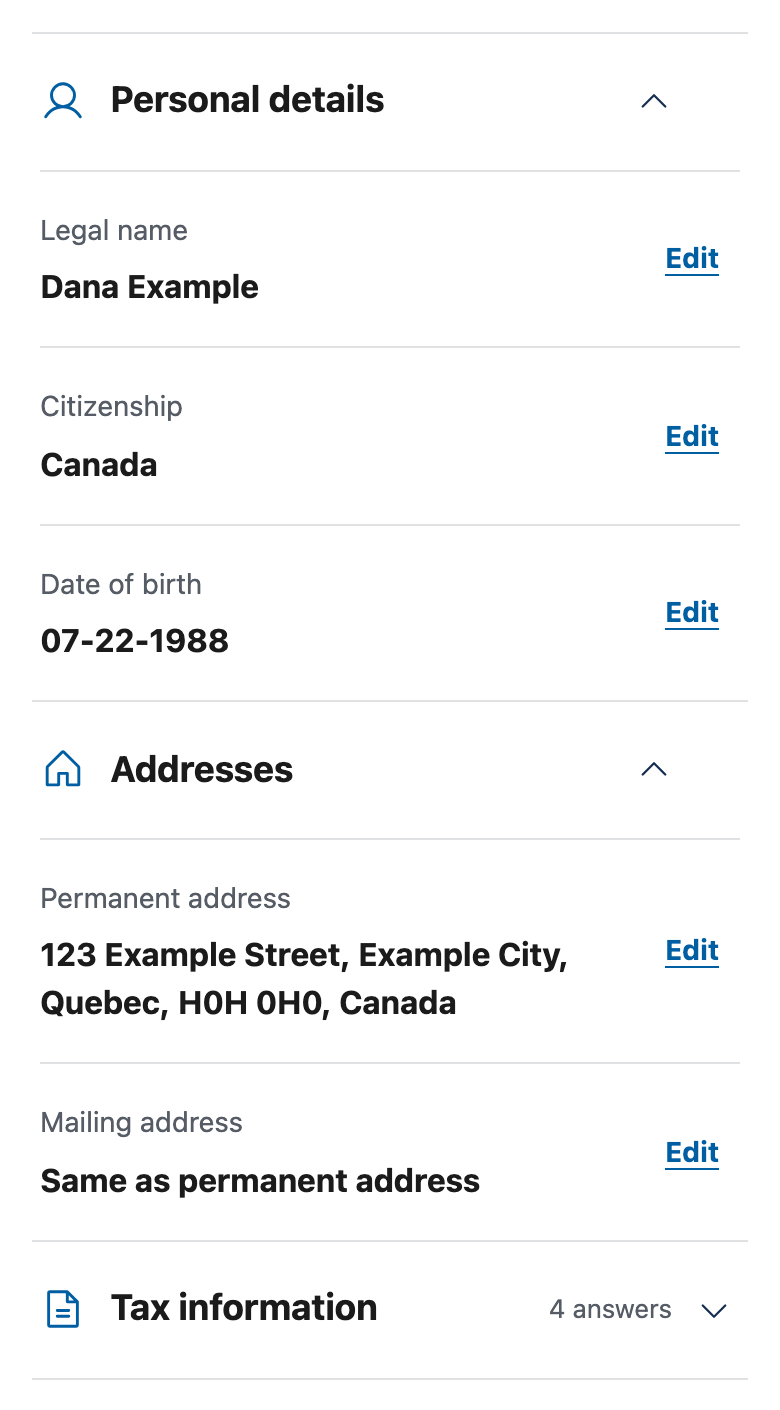
The answer-review panel in our W-8BEN interview, using the fictional Dana Example fixture. This is our preparation tool; a payer’s tax portal has its own screens and submission process.
Open full-size screenshotOpen full-size screenshot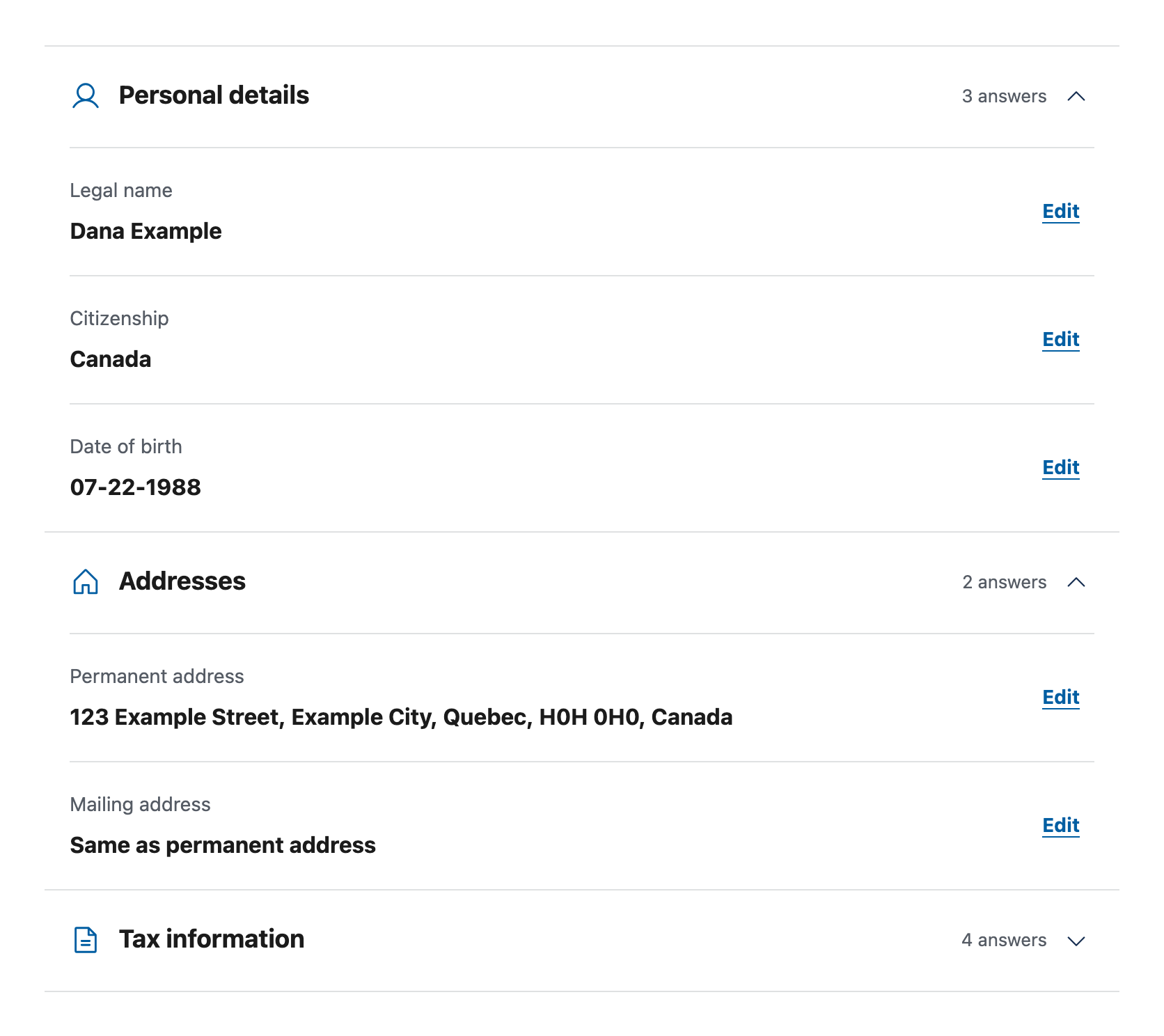
- Review the answers in each section
Check Personal details and Addresses, then expand Tax information to review the remaining answers.
Back to screenshot - Use Edit to correct an answer
Each Edit button returns to that question so you can correct it before continuing. Completing and reviewing the answers is free; signing and downloading come after payment.
Back to screenshot
Patreon’s fields, mapped to Form W-8BEN
Patreon’s electronic form uses the IRS line numbers, and its help article quotes the IRS instructions for Lines 8 and 9 word for word. This table tells you what each field is for and what to enter.
| Field in Patreon’s form | Line on Form W-8BEN | What to enter |
|---|---|---|
| Fill out W-8BEN form or Fill out W-8BEN-E | Chooses W-8BEN (individual) or W-8BEN-E (entity) | Patreon says individuals fill out W-8BEN and entities fill out W-8BEN-E. Choose the entity form only if a company, not you, is the payee. |
| Name of individual | Line 1 | Your legal name. Not your creator name. |
| Country of citizenship | Line 2 | Your citizenship, which can differ from where you live. |
| Permanent residence address | Line 3 | Street address in your country of tax residence. Not a U.S. address. |
| Mailing address | Line 4 | Only if different from Line 3. Otherwise leave blank. |
| U.S. taxpayer identification number | Line 5 | Optional. Almost every non-U.S. creator leaves it blank. |
| Foreign tax identifying number, with country of issuance | Line 6a | Your home-country tax number, digits only, in the format from Patreon’s table. Patreon lets you add more than one TIN if you have them. |
| FTIN not legally required | Line 6b | Tick only if your country does not issue TINs. Patreon expects a TIN from creators in most countries. |
| VAT/GST Identification Number | Patreon labels this Line 7 | Optional. On the official IRS form Line 7 is a reference number. Patreon uses the slot for your VAT or GST ID. |
| Date of birth | Line 8 | Required. Patreon’s format is MM-DD-YYYY. |
| Are you claiming tax treaty benefits? | Line 9 (country) | Yes or no. See the next section. Most Patreon creators can answer no. |
| Special rates and conditions | Line 10 (article, rate, income type) | Only if you answered yes and know the article and income type. Patreon does not name one. |
| Certification and signature | Part III | Type your legal name and the date. Sign as yourself. Tick the capacity box if the form shows one, and leave any free-text capacity field blank. |
Does the treaty section matter on Patreon?
Short answer: rarely. Patreon’s EU tax FAQ describes treaty benefits as a way to avoid being taxed twice, then says: “For most people, this is inapplicable, and only your home country (assuming you live where you are a citizen) will tax your income.”
That fits what Patreon says elsewhere. A treaty rate on Line 10 reduces U.S. withholding. Patreon does not withhold U.S. tax on creator earnings. So a treaty claim has nothing to reduce, and the payout is the same either way.
There is a second reason to keep it simple. To cite a rate on Line 10 you must name the type of income and the treaty article that covers it. Google tells YouTube creators that their revenue is copyright royalties. Patreon’s help centre does not say whether it treats memberships as royalties or as payments for services, and the treaty article differs between the two. Without that statement from Patreon, a Line 10 entry would be a guess. We have left our treaty rate table off this page for that reason.
What that means in practice:
- Answer “no” to “Are you claiming tax treaty benefits?” if you want the simplest valid form. Patreon still needs your foreign TIN on Line 6a.
- If you answer “yes”, fill in your country on Line 9 and leave Line 10 empty unless a tax adviser tells you which article applies to you. A country on Line 9 with no Line 10 is a complete and common form.
Why creators paid by Patreon’s Irish entity still sign a W-8BEN
Many European creators are paid by Patreon Ireland Ltd and ask why a U.S. form applies to them. Patreon’s answer: “As per our terms, all Creators contract with Patreon, Inc., a U.S. entity. As such, all payments are coming from the U.S. entity.” The contracting party is American, so the U.S. documentation rules apply, whichever subsidiary moves the money.
Being paid in euros or pounds does not change that. Nor does living in a country with no U.S. treaty at all. The W-8BEN certifies foreign status. It does not depend on a treaty existing.
Common mistakes that hold up a payout
Patreon does not publish a rejection list the way Google does, but its articles and the IRS instructions point to the same handful of errors.
- Creator name on Line 1. The form is about you, the beneficial owner. Put the name on your ID, and make sure it matches your payout method.
- A U.S. address on Line 3. A W-8BEN certifies that you are not a U.S. person. A U.S. residence address says the opposite.
- A blank or badly formatted TIN. Patreon’s form will not submit with a TIN in the wrong format, and dashes or slashes are a common cause. Check the expected digit count in Patreon’s table first.
- Confusing a VAT number with a TIN. They go in different fields. Patreon says the VAT number is optional and the TIN is expected.
- Filling in Line 10 with a guessed article. If you are not sure, leave it blank. It does not affect what Patreon pays you.
- Filing the wrong form. A creator whose page is paid to a limited company needs W-8BEN-E, not W-8BEN. See the next section.
- Not updating after a move. The IRS instructions require a new form within 30 days of a change in circumstances, such as a new country of residence. Use Patreon’s Update link.
Creators paid through a company
Some creators are paid through a company, an LLC outside the U.S., or another organization that is separate from them for tax purposes. If that is you, Patreon’s Fill out W-8BEN-E button is the one you need. That form asks about the entity’s classification and its treaty eligibility, and Patreon puts the VAT or GST field on its Line 9c. Our W-8BEN-E interview walks through those questions. If you are unsure which form fits, start with Which W-8 form do I need?.
How long the form lasts
Life of a W-8BEN submitted to Patreon
The IRS rule: the form stays valid from the date you sign it until the last day of the third calendar year that follows, unless your circumstances change first.
You submit the form in Patreon's Tax settings
Patreon can now pay out your funds. Nothing is withheld for U.S. tax, before or after.
Your address, country, or legal name changes
The IRS instructions require a new form within 30 days of a change in circumstances. Use the Update link under Tax settings in Patreon.
Each payout
Patreon keeps paying on your normal schedule while a valid form is on file. Check that your payout method still carries the same legal name as Line 1.
December 31, 2029
The form expires at the end of the third full calendar year after 2026. Submit a new one through the Update link so payouts continue without a gap.
Important: The example dates assume a signature in 2026 and no change in circumstances. Patreon's help centre does not describe an expiry reminder, so set your own.
Worked examples
All names are fictional.
Tomasz, an illustrator in Poland, earns about $900 a month from members in twelve countries, including the United States. He answers “no” to the treaty question, enters his PESEL on Line 6a as digits only, and adds his VAT number because he is registered. Patreon releases his payouts and withholds nothing. His U.S. members change nothing about the form.
Beatriz, a fitness coach in Brazil, worries because Brazil has no U.S. tax treaty. It does not matter here. She files W-8BEN with no treaty claim, her CPF on Line 6a, and her Sao Paulo address on Line 3. Patreon does not withhold U.S. tax, treaty or not, so her payout is the same as Tomasz’s would be.
Aoife, a podcaster in Ireland, is paid by Patreon Ireland in euros and assumes the U.S. form does not apply. Her payout stays on hold until she submits it. She contracts with Patreon, Inc., so she files W-8BEN with her PPS number and the form goes through.
Diego, a musician in Mexico, files W-8BEN like everyone else. Patreon also withholds Mexican income tax from his earnings under Mexican law. The rate is 20% without an RFC and 2.5% with an individual RFC. That is a Mexican rule, and providing his RFC on Patreon’s tax form is what lowers it, not anything on the U.S. form.
Hana, a writer in Japan, typed her pen name on Line 1. Her payout method is in her legal name, so the two do not match. She uses the Update link, replaces the pen name with her legal name, and keeps the pen name on her page where it belongs.
Frequently asked questions
Do I need a W-8BEN for Patreon if I have no U.S. members?
Yes. Patreon requires a W-8BEN or W-8BEN-E from every creator who is not a U.S. citizen before it will pay out funds. The requirement is tied to being paid at all, not to where your members live.
Does Patreon withhold U.S. tax from non-U.S. creators?
Patreon's help centre says it does not withhold any taxes from funds earned on Patreon. The W-8BEN is how Patreon documents you as a non-U.S. person so that it can pay you in full and leave you out of its U.S. reporting. Creators in Mexico are a separate case: since October 2025 Patreon withholds Mexican income tax under Mexican law.
Should I claim tax treaty benefits on Patreon's W-8BEN?
Usually there is no need. Patreon says treaty benefits are inapplicable for most people, and because Patreon does not withhold U.S. tax there is no rate to reduce. Answering no is a complete, valid form. If you answer yes, fill in your country on Line 9 and leave Line 10 blank unless a tax adviser gives you the article.
I am paid by Patreon Ireland. Why do I still need a U.S. tax form?
Patreon's terms have every creator contract with Patreon, Inc., a U.S. company, and Patreon says all payments come from that U.S. entity. The Irish subsidiary is the paying agent, so the U.S. documentation rules still apply.
Which tax number does Patreon want on the W-8BEN?
Your home-country tax identification number on Line 6a, entered in the format Patreon lists for your country and without dashes or slashes. Patreon's examples include Canada's Social Insurance Number, Ireland's PPS number, Germany's Steuerliche Identifikationsnummer, and Australia's Tax File Number. A VAT or GST number is optional and goes in a separate field.
Where is the tax form in Patreon settings?
Open Settings, then the Payouts and Taxes tab, which newer articles call Billing and Payouts. Scroll to Tax settings at the bottom and click Fill out W-8BEN form, or Fill out W-8BEN-E for a company. If a form is already on file you see an Update link instead.
My Patreon page is run through my company. Which form do I file?
Form W-8BEN-E, using the Fill out W-8BEN-E button in Patreon's Tax settings. Patreon says entities file W-8BEN-E and individuals file W-8BEN. Our W-8BEN-E interview at /start/w8bene/ covers the entity questions.
When does a Patreon W-8BEN expire?
Under the IRS instructions, at the end of the third calendar year after the year you signed it, unless a change in circumstances such as a new country of residence ends it earlier. A form signed in 2026 lasts until December 31, 2029. The IRS requires a new form within 30 days of a change, and Patreon provides an Update link for that.