Form W-8BEN-E
Form W-8BEN-E explained: who files it, the parts that matter, and how to prepare one
Eight pages look worse than they are. A foreign company that sells products or services and is not a bank usually completes four parts. This guide shows which four, and what each line wants.
Form W-8BEN-E is the certificate a foreign entity gives to a U.S. payer, bank, or broker to establish that it is not a U.S. person, to state its classification for two sets of U.S. rules, and, when it qualifies, to claim a reduced treaty rate. It is the entity counterpart of Form W-8BEN. The IRS instructions describe its users as foreign entities receiving withholdable payments, payments subject to chapter 3 withholding, or maintaining accounts at foreign financial institutions.
The form runs to eight pages and thirty parts because it must cover every kind of entity from a corner shop to a sovereign wealth fund. A single operating company touches a small fraction of it. This guide is educational information, not tax advice, and it focuses on that common case.
Who files it, and who does not
The instructions draw the lines clearly.
- Use W-8BEN-E if you are a foreign entity that is the beneficial owner of the income, or that holds an account with a financial institution that asks for it.
- Do not use it if you are a U.S. entity (Form W-9), a nonresident alien individual (Form W-8BEN), a foreign partnership documenting its partners (Form W-8IMY), an entity claiming that the income is effectively connected with a U.S. trade or business (Form W-8ECI), or a disregarded entity or branch, whose owner documents itself instead.
The disregarded-entity rule catches single-owner companies. If U.S. tax law looks through the entity to its owner, the owner’s form is the one the payer needs. The exception is a hybrid entity making a treaty claim, which completes W-8BEN-E in its own name. Whether a foreign company is disregarded or a corporation for U.S. purposes is a classification question; many foreign limited companies are corporations by default and complete the form themselves.

- An individual
- The person receives the income for their own account.
- An entity
- The organization receives the income for its own account.
The number of people in the picture does not decide the form. A one-person company can be an entity; U.S. tax classification and the ownership of the income matter. Check the exceptions in this guide.
The four parts an operating company completes
| Comparison | Almost always | Sometimes | Rarely, for specific entity types |
|---|---|---|---|
| Parts | Part I (identification), Part III (treaty claim, if any), Part XXV (active NFFE) or XXVI (passive NFFE), Part XXX (certification) | Part II (disregarded entity or branch receiving the payment), Part XXIX (substantial U.S. owners of a passive NFFE) | Parts IV to XXIV, XXVII, XXVIII: financial institutions, governments, pension funds, nonprofits, start-ups, and other categories |
| Pages | 1, 2, 7, and 8 | 2 and 8 | 3 to 7 |
Part I: identification of beneficial owner
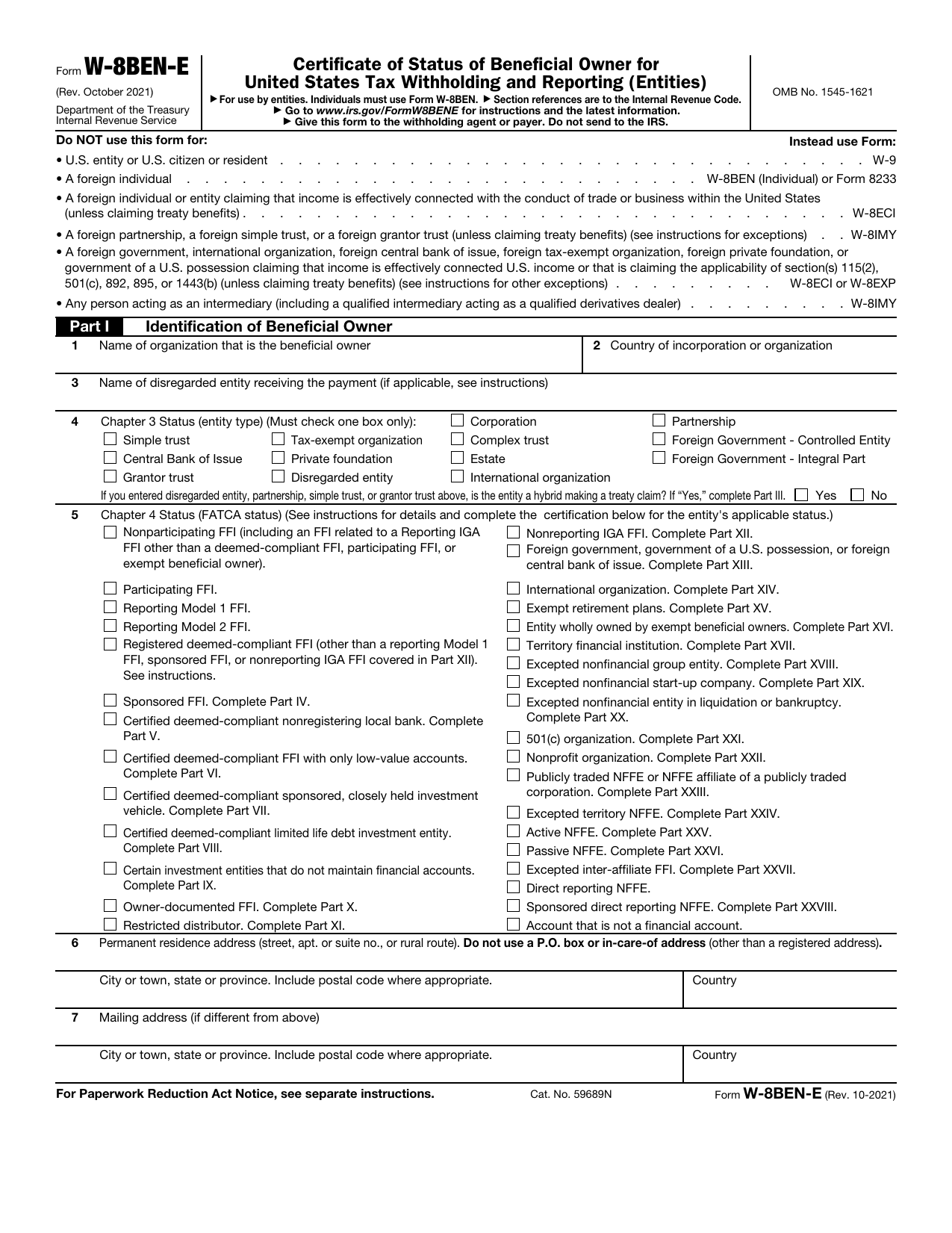
Page 1 of the blank entity form, rendered from the IRS PDF. Lines 8 to 10 and Part II continue on page 2.
- Back to figure
Line 1: name of organization
The entity's registered legal name.
- Back to figure
Line 2: country of incorporation
Where the entity was formed.
- Back to figure
Line 3: disregarded entity receiving the payment
Usually blank.
- Back to figure
Line 4: chapter 3 status
One box. A foreign limited company is almost always a corporation.
- Back to figure
Line 5: chapter 4 (FATCA) status
One box from more than 30. An operating company is normally an active NFFE.
- Back to figure
Line 6: permanent residence address
The entity's address in its country of tax residence, without a PO box.
- Back to figure
Line 7: mailing address
Only if different from Line 6.
Line 1: name of organization. The entity’s legal name as registered in its country. Not a trading name.
Line 2: country of incorporation or organization. Where the entity was formed.
Line 3: name of disregarded entity receiving the payment. Usually blank. It is for a disregarded entity that holds a GIIN or is a reporting financial institution, or for a branch.
Line 4: chapter 3 status. One box: corporation, partnership, simple trust, grantor trust, complex trust, estate, government, central bank of issue, tax-exempt organization, private foundation, international organization, or disregarded entity. A foreign limited company, GmbH, Pty Ltd, SAS, or Private Limited is almost always a corporation here. If you tick partnership, the instructions send you to Form W-8IMY instead.
Line 5: chapter 4 status. This is the FATCA classification and the line that stops most people. The decision flow in the next section resolves it for the common cases. Each box names the part of the form you must also complete. Some payers, such as a U.S. client paying for services, do not need chapter 4 status at all and will say so; in that case the instructions allow the line to be left blank.
Line 6: permanent residence address. The entity’s address in its country of tax residence. No PO box, no in-care-of address, no registered agent address in a different country.
Line 7: mailing address. Only if different.
Line 8: U.S. taxpayer identification number. An EIN, if the entity has one. Most foreign companies do not and do not need one unless they claim a treaty benefit without a foreign TIN, or hold certain accounts.
Line 9a: GIIN. Only for financial institutions registered with the IRS.
Line 9b: foreign TIN. The entity’s tax number in its home country. The foreign TIN guide lists the entity number for many countries. Line 9c is the checkbox for entities not legally required to obtain one.
Line 10: reference number. Optional, for an account number or similar.
Chapter 4 status for a normal company
Chapter 4 is the FATCA regime. Its categories divide the world into financial institutions and everything else, and “everything else” is a non-financial foreign entity, or NFFE. An NFFE is active if less than half of its gross income for the preceding year was passive income and less than half of its assets produce passive income. Otherwise it is passive.
Which chapter 4 box applies?
A simplification of the instructions for the entity types most likely to be reading this. Financial institutions and unusual structures need the full instructions.
Is the entity a bank, broker, custodian, insurance company, or an investment fund or vehicle?
Foreign financial institution categories
Participating, reporting Model 1 or 2, registered deemed-compliant, and others. Most need a GIIN on Line 9a. Get advice.
Is the entity publicly traded, or owned by a publicly traded company?
Publicly traded NFFE or affiliate
Part XXIII. Enter the exchange and the traded entity's name.
In the last year, was less than half of the entity's gross income passive (dividends, interest, rents, royalties not from an active business), and less than half of its assets held to produce passive income?
Active NFFE
Part XXV. One checkbox certifying the income and asset tests. This is where most operating companies land.
Passive NFFE
Part XXVI. Certify the status and either state there are no substantial U.S. owners or list them in Part XXIX.
A software company, a design agency, a manufacturer, a consultancy, or a game studio is an active NFFE. It ticks the active NFFE box on Line 5 and, in Part XXV, ticks the single certification that it meets the income and asset tests. That is the whole of the FATCA work.
A holding company that lives on dividends, a family investment company, or a property company is usually a passive NFFE. It ticks the passive NFFE box and completes Part XXVI, where it certifies either that it has no substantial U.S. owners, meaning no U.S. person owning more than 10%, or that it has listed them in Part XXIX with names, addresses, and U.S. TINs.
Part III: treaty claim
Part III is optional and only applies where the entity’s country has an income tax treaty with the United States that is in force.
Line 14a names the treaty country. Line 14b is the part that has no equivalent on the individual form: the entity must tick the limitation-on- benefits test it satisfies. The list includes government, tax-exempt pension fund, other tax-exempt organization, publicly traded corporation, subsidiary of a publicly traded corporation, company that meets the ownership and base erosion test, company that meets the derivative benefits test, company with an item of income that meets the active trade or business test, favorable discretionary determination, no limitation-on-benefits article in the treaty, and other.
For a privately held operating company, the two usual answers are the ownership and base erosion test, broadly that residents of the treaty country own most of the company and most of its income is not paid out to non-residents, and the active trade or business test, that the income is connected with an active business in the treaty country. The tests are defined in each treaty’s own limitation-on-benefits article, and getting them wrong invalidates the claim. This is the point at which a treaty claim by an entity deserves professional confirmation.
Line 15 is the entity version of the individual form’s Line 10: the article, rate, income type, and explanation, required in the same defined cases such as royalties where the treaty has different rates for different types.
Withholding rates on U.S.-source royalties by treaty country
The same rates apply to entities and individuals. An entity must also satisfy a limitation-on-benefits test on Line 14b before it can claim them.
Your selection stays in this browser tab and is not sent anywhere.
Show the full table for every treaty country
| Country | Copyright royalties | Film and TV royalties | Treaty article |
|---|---|---|---|
| Armenia | 0% | 0% | III(1)(a) (U.S.–U.S.S.R. treaty) |
| Australia | 5% | 5% | 12(2) / P8 |
| Austria | 0% | 10% | 12(1), (2) |
| Azerbaijan | 0% | 0% | III(1)(a) (U.S.–U.S.S.R. treaty) |
| Bangladesh | 10% | 10% | 12(2) |
| Barbados | 5% | 5% | 12(2) / 1PV; 2PII(6) No treaty benefit if the recipient is under a special low-tax regime (Table 1 footnote rr). |
| Belarus | 30% | 30% | Treaty partially suspended The IRS lists the U.S.–U.S.S.R. treaty as partially suspended for Belarus. Treat the rate as 30% unless a tax adviser confirms otherwise. |
| Belgium | 0% | 0% | 12(1) |
| Bulgaria | 5% | 5% | 12(2) / P5(7) |
| Canada | 0% | 10% | XII(2), (3) / 5P7(1) |
| Chile | 10% | 10% | 12(1)–(6) |
| China | 10% | 10% | 11(2) |
| Cyprus | 0% | 0% | 14(1) |
| Czech Republic | 0% | 0% | 12(2) |
| Denmark | 0% | 0% | 12(1) |
| Egypt | 15% | Not covered by the royalty article | 13(1) |
| Estonia | 10% | 10% | 12(2) |
| Finland | 0% | 0% | 12(1) |
| France | 0% | 0% | 12(1) / 2PIII |
| Georgia | 0% | 0% | III(1)(a) (U.S.–U.S.S.R. treaty) |
| Germany | 0% | 0% | 12(1) |
| Greece | 0% | 30% | VII |
| Hungary | 30% | 30% | Treaty terminated The IRS lists the U.S.–Hungary treaty as terminated. The statutory 30% rate applies. |
| Iceland | 0% | 5% | 12(1), (2) |
| India | 15% | 15% | 12(2)–(4) |
| Indonesia | 10% | 10% | 13(2) / P34 |
| Ireland | 0% | 0% | 12(1) |
| Israel | 10% | 10% | 14(1) |
| Italy | 0% | 8% | 12(2) Italy taxes software royalties at the industrial-equipment rate rather than the copyright rate (Table 1 footnote tt). |
| Jamaica | 10% | 10% | 12(2) |
| Japan | 0% | 0% | 12(1) |
| Kazakhstan | 10% | 10% | 12(2) |
| Kyrgyzstan | 0% | 0% | III(1)(a) (U.S.–U.S.S.R. treaty) |
| Latvia | 10% | 10% | 12(2) |
| Lithuania | 10% | 10% | 12(2) |
| Luxembourg | 0% | 0% | 13(1) |
| Malta | 10% | 10% | 12(2) |
| Mexico | 10% | 10% | 12(2) |
| Moldova | 0% | 0% | III(1)(a) (U.S.–U.S.S.R. treaty) |
| Morocco | 10% | 10% | 12(2) |
| Netherlands | 0% | 0% | 13(1) |
| New Zealand | 5% | 5% | 12(2) / PVIII |
| Norway | 0% | Not covered by the royalty article | 10(1) |
| Pakistan | 0% | Not covered by the royalty article | VIII(1) Payments for TV broadcasting rights fall under the royalty article, but rental income from motion picture films does not (Table 1 footnote u). |
| Philippines | 15% | 15% | 13(2) The Philippine domestic rate differs from the U.S. treaty rate (Table 1 footnote vv). |
| Poland | 10% | 10% | 13(2) |
| Portugal | 10% | 10% | 13(2) |
| Romania | 10% | 10% | 12(2) |
| Russia | 30% | 30% | Treaty partially suspended The IRS lists the U.S.–Russia treaty as partially suspended, and the suspension covers the royalties article. Treat the rate as 30%. |
| Slovak Republic | 0% | 0% | 12(2) |
| Slovenia | 5% | 5% | 12(1) |
| South Africa | 0% | 0% | 12(1) |
| South Korea | 10% | 10% | 14(1) |
| Spain | 0% | 0% | 12(1) / PVI |
| Sri Lanka | 10% | 10% | 12(2) |
| Sweden | 0% | 0% | 12(1) |
| Switzerland | 0% | Not covered by the royalty article | 12(1) |
| Tajikistan | 0% | 0% | III(1)(a) (U.S.–U.S.S.R. treaty) |
| Thailand | 5% | 5% | 12(2) |
| Trinidad and Tobago | 0% | Not covered by the royalty article | 14(1) 15% for copyrights of scientific work (Table 1 footnote cc). |
| Tunisia | 15% | 15% | 12(2)–(3) |
| Turkey | 10% | 10% | 12(2) |
| Turkmenistan | 0% | 0% | III(1)(a) (U.S.–U.S.S.R. treaty) |
| Ukraine | 10% | 10% | 12(2) |
| United Kingdom | 0% | 0% | 12(1) |
| Uzbekistan | 0% | 0% | III(1)(a) (U.S.–U.S.S.R. treaty) |
| Venezuela | 10% | 10% | 12(2) |
| Any other country | 30% | 30% | No treaty. Common examples: Argentina, Brazil, Colombia, Ghana, Hong Kong, Kenya, Malaysia, Nigeria, Peru, Saudi Arabia, Singapore, Taiwan, United Arab Emirates, Vietnam. |
Read before relying on a rate: figures are transcribed from IRS Tax Treaty Table 1 (Rev. May 2023), columns for income codes 11 and 12. The table itself warns that it is not a complete statement of eligibility. Limitation-on-benefits rules, residence tests, and the payer's own review can change the outcome.
Part XXX: certification
An authorized individual signs on behalf of the entity, prints their name, dates the form, and ticks the box certifying that they have the capacity to sign, just as an individual does in Part III of Form W-8BEN. The certification covers the entity’s foreign status, beneficial ownership, the chapter 4 status claimed, and any treaty claim. Electronic signatures are accepted on the same terms as for W-8BEN: a timestamp and a statement that the form was signed electronically.
The form is valid from the signature date until December 31 of the third succeeding calendar year, and the entity must give the payer a new form within 30 days of any change in circumstances. The expiration guide has a calculator that works for both forms.
Preparing one without a tax adviser
It is realistic for a small foreign corporation to complete W-8BEN-E itself when all of the following are true.
- It is a corporation for U.S. purposes, not a partnership, trust, or disregarded entity.
- It receives the income for itself, not for clients or members.
- The income is not effectively connected with a U.S. trade or business.
- It runs an active business, so it is an active NFFE, or the payer has confirmed it does not need chapter 4 status.
- It is not claiming a treaty rate, or it can clearly satisfy a limitation-on-benefits test.
Our W-8BEN-E interview is deliberately limited to the first four of those and to entities that are not claiming a treaty benefit. It screens for each condition before asking for company details, stops if an answer points elsewhere, and produces the official form with Parts I, XXV, and XXX completed for review and signature. Entities outside that scope, including any entity making a treaty claim, should work from the IRS instructions or with an adviser.
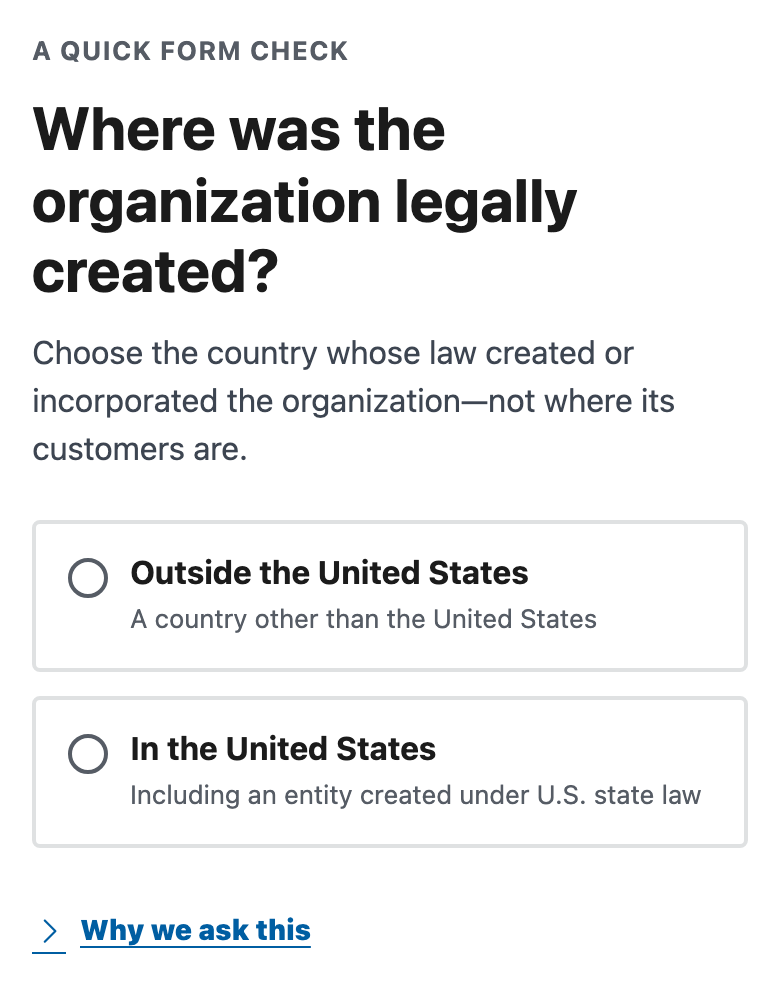
The opening screen of our limited W-8BEN-E interview. Later screening questions determine whether the tool supports the entity’s circumstances.
Open full-size screenshotOpen full-size screenshot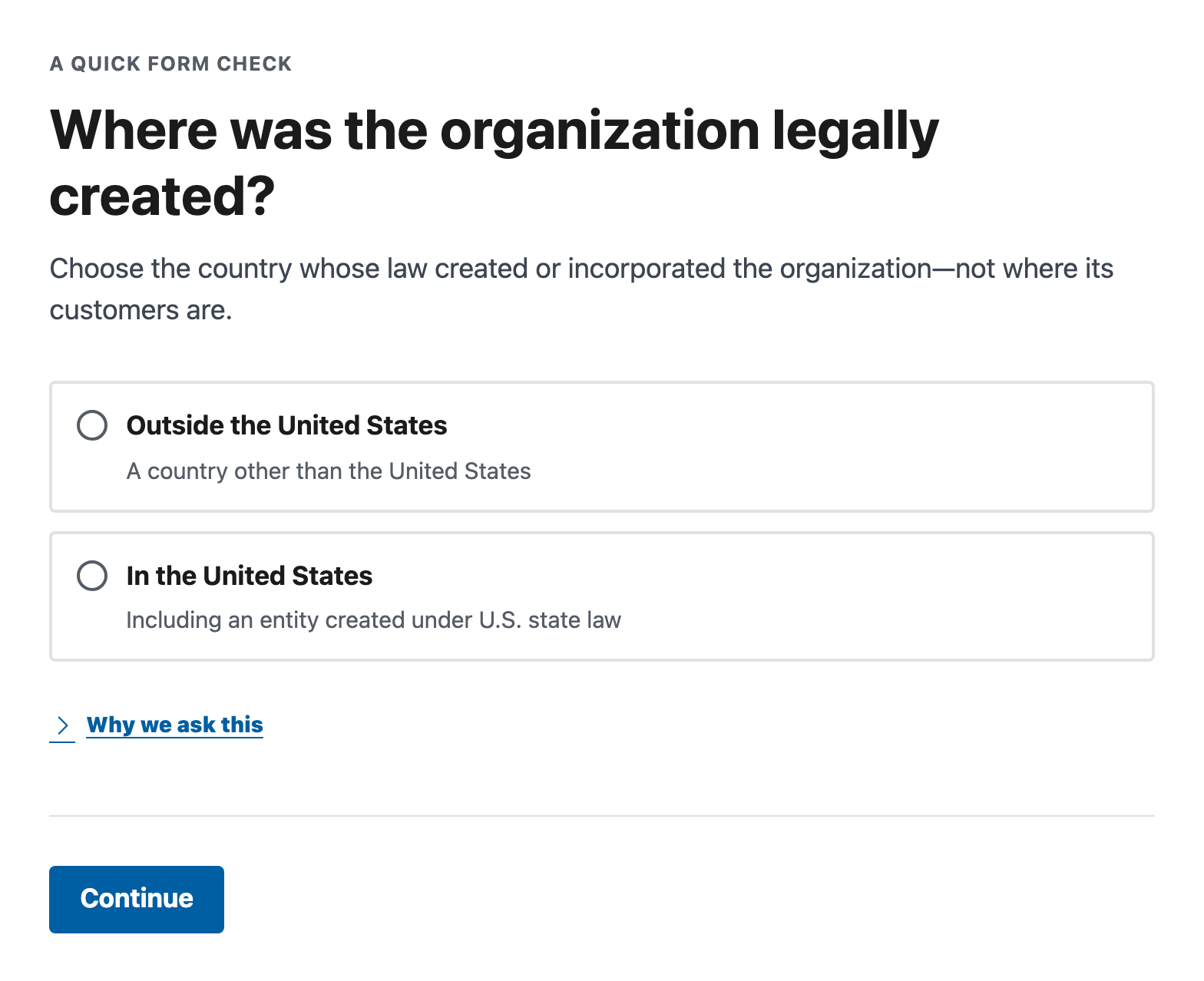
- Answer for the organization itself
Choose where the organization was legally created. The interview asks further questions before collecting company details; this first answer alone does not establish eligibility.
Back to screenshot
Worked example
Kestrel Analytics Pty Ltd, an Australian company with four employees, sells subscription software to a U.S. customer that asks for a W-8BEN-E before paying its invoices. The company is a corporation, receives the fees for itself, has no U.S. office, and earns all its income from subscriptions.
It completes Part I with its legal name, Australia on Line 2, corporation on Line 4, active NFFE on Line 5, its Melbourne address on Line 6, and its Australian Business Number on Line 9b. It skips Part III because the subscription fees are for services performed in Australia, which are foreign-source and not subject to U.S. withholding, so there is no rate to reduce. It ticks the certification in Part XXV. A director signs Part XXX, ticks the capacity box, and dates the form. The customer keeps it on file and pays the invoices in full.
Frequently asked questions
What is Form W-8BEN-E used for?
It is the certificate a foreign entity gives a U.S. payer, bank, or broker to establish that it is not a U.S. person, to state its chapter 3 and chapter 4 classifications, and, where it qualifies, to claim a reduced treaty rate of withholding. It is given to the payer, not filed with the IRS.
Which parts of Form W-8BEN-E do I need to complete?
A foreign operating company that is not a financial institution usually completes Part I, Part XXV (active NFFE) or Part XXVI (passive NFFE), Part XXX (certification), and Part III only if it claims a treaty rate. The remaining parts apply to banks, funds, governments, nonprofits, and other specific entity types.
What is the chapter 4 status for a normal company?
Almost always active NFFE: a non-financial foreign entity with less than half of its income and assets passive. It ticks that box on Line 5 and the single certification in Part XXV. A holding or investment company is usually a passive NFFE and completes Part XXVI instead.
Does a foreign company need a U.S. EIN for Form W-8BEN-E?
Not usually. Line 8 asks for an EIN only if the entity has one. A foreign TIN on Line 9b supports a treaty claim in place of an EIN. An EIN is needed only in specific cases described in the instructions, such as certain accounts and claims.
What is the limitation on benefits box on Line 14b?
It is the test an entity must satisfy under the treaty's limitation-on-benefits article to claim treaty rates. Privately held operating companies typically rely on the ownership and base erosion test or the active trade or business test. The tests are defined in each treaty and are the usual reason an entity treaty claim needs professional review.
Can a single-member LLC file Form W-8BEN-E?
If the entity is disregarded for U.S. tax purposes, no: its owner provides the appropriate form, which is W-8BEN for an individual owner. If the foreign entity is classified as a corporation, it files W-8BEN-E in its own name. A hybrid entity claiming treaty benefits is the exception and completes W-8BEN-E.
How long is Form W-8BEN-E valid?
From the date it is signed until the last day of the third succeeding calendar year, unless a change in circumstances makes the information incorrect first. The rule is the same as for Form W-8BEN.
Who signs Form W-8BEN-E?
An individual authorized to sign for the entity, such as a director or officer. They sign and date Part XXX, print their name, and tick the box certifying that they have the capacity to sign on the entity's behalf.
Important: This guide provides general educational information, not tax or legal advice. Entity classification, chapter 4 status, and treaty limitation-on-benefits tests are determinations that can require professional review. Read the current IRS instructions before completing the form.