Completing Form W-8BEN
Foreign tax identifying number for Form W-8BEN: what it is and what to enter, by country
Line 6 of Form W-8BEN asks for a number most people already have but rarely call by that name. This guide names it for your country, shows where to find it, and explains the two cases where the line stays blank.
A foreign tax identifying number, or foreign TIN, is the number your own country’s tax authority uses to identify you. It is not a U.S. number. On Form W-8BEN it goes on Line 6a, and on Form W-8BEN-E it goes on Line 9b. The IRS instructions call it “a tax identifying number issued to you by your jurisdiction of tax residence”.
Most people already have one. In the United Kingdom it is the Unique Taxpayer Reference or the National Insurance number. In India it is the PAN. In Canada it is the Social Insurance Number. In Germany it is the 11-digit Steuer-ID. The confusion comes from the label, not the number.
This guide is educational information, not tax advice. It explains what the IRS and the main platforms ask for and where to find your number.
Find the number for your country
Choose your country to see the name of the number, its usual format, where it appears, and what to do on Line 6. The full table covers 50 countries.
Which number goes on W-8BEN Line 6a?
Names and formats are taken from each tax authority and the OECD TIN portal. Nothing you select here is stored or sent.
Your selection stays in this browser tab and is not sent anywhere. Do not type your number into this page.
- Typical format
- Where to find it
- For a company (W-8BEN-E Line 9b)
Show the full table for every listed country
| Country | Number to enter on Line 6a | Typical format | Where to find it |
|---|---|---|---|
| Argentina | CUIL or CUIT | 11 digits, written XX-XXXXXXXX-X | On your CUIL card, in the AFIP (ARCA) online account, or on any tax filing. |
| Australia | Tax File Number (TFN) On the IRS no-TIN list: Line 6a may be left blank. | 8 or 9 digits | In your ATO online account through myGov, or on a notice of assessment. |
| Austria | Steuernummer (tax number) or the 9-digit Abgabenkontonummer | 9 digits, often written XX-XXX/XXXX | On correspondence from your Finanzamt or in FinanzOnline. Not everyone has one; people without one can tick Line 6b. |
| Bangladesh | e-TIN | 12 digits | On the e-TIN certificate issued by the National Board of Revenue. |
| Belgium | National register number (numéro national / rijksregisternummer) | 11 digits, written YY.MM.DD-XXX.XX | On the back of your identity card and on the eID chip. |
| Brazil | CPF (Cadastro de Pessoas Físicas) | 11 digits, written 000.000.000-00 | On your CPF card, the Receita Federal app, or any bank statement. |
| Canada | Social Insurance Number (SIN) | 9 digits | On your SIN confirmation letter, a notice of assessment, or in CRA My Account. |
| Chile | RUN / RUT (Rol Único Tributario) | 7 or 8 digits plus a check digit, written XX.XXX.XXX-X | On your cédula de identidad. |
| China | Citizen identification number, used as the TIN | 18 characters | On your resident identity card. |
| Colombia | NIT (Número de Identificación Tributaria) | Usually your cédula number plus a check digit | On the RUT certificate from DIAN. If you have never registered, ask DIAN before ticking Line 6b. |
| Czech Republic | Rodné číslo (birth number), or DIČ if you are registered | 9 or 10 digits; DIČ is CZ followed by the digits | On your identity card or in the tax portal (Moje daně). |
| Denmark | CPR number | 10 digits, written DDMMYY-XXXX | On your health insurance card (sundhedskort) and in TastSelv. |
| Egypt | Tax registration number | 9 digits | On your tax card from the Egyptian Tax Authority. |
| Finland | Personal identity code (henkilötunnus) | DDMMYY, a century mark, then 3 digits and a check character | On your identity card, passport, or Kela card. |
| France | Numéro fiscal de référence (also called NIF or SPI) | 13 digits, starting with 0, 1, 2, or 3 | At the top of your avis d'imposition and in your impots.gouv.fr account. |
| Germany | Steuerliche Identifikationsnummer (Steuer-ID or IdNr) | 11 digits | On the letter from the Bundeszentralamt für Steuern, on your Lohnsteuerbescheinigung, and on tax assessments. The Steuernummer from your local Finanzamt is a different number; the IdNr is the one to use. |
| Greece | AFM (Αριθμός Φορολογικού Μητρώου) | 9 digits | On any document from the tax authority (AADE) and in myAADE. |
| Hong Kong | Hong Kong Identity Card number, used as the tax file reference | 1 or 2 letters, 6 digits, and a check character in brackets | On your Hong Kong identity card. |
| Hungary | Adóazonosító jel (tax identification sign) | 10 digits | On your tax card (adókártya). |
| India | Permanent Account Number (PAN) | 10 characters: 5 letters, 4 digits, 1 letter | On your PAN card and in the income tax e-filing portal. Aadhaar is not a tax number for this purpose. |
| Indonesia | NPWP (Nomor Pokok Wajib Pajak) | 15 digits, moving to the 16-digit NIK | On your NPWP card or in DJP Online. |
| Ireland | PPS Number (PPSN) | 7 digits followed by 1 or 2 letters | On your Public Services Card, payslips, and Revenue correspondence. |
| Israel | Identity number (Teudat Zehut), used as the tax number | 9 digits | On your identity card. |
| Italy | Codice fiscale | 16 characters, letters and digits | On your tessera sanitaria and identity documents. |
| Japan | Individual Number (My Number) On the IRS no-TIN list: Line 6a may be left blank. | 12 digits | On your My Number card or notification card. |
| Kenya | KRA PIN | A letter, 9 digits, and a letter | On your KRA PIN certificate from iTax. |
| Malaysia | Income tax number (Nombor Cukai Pendapatan) | Two letters followed by up to 11 digits, for example IG or SG series | In your MyTax account or on LHDN correspondence. |
| Mexico | RFC (Registro Federal de Contribuyentes) | 13 characters for individuals: 4 letters, 6 digits, 3 characters | On your constancia de situación fiscal from SAT. The CURP is not a tax number for this purpose. |
| Netherlands | Burgerservicenummer (BSN) | 9 digits | On your passport, identity card, driving licence, and Belastingdienst letters. |
| New Zealand | IRD number | 8 or 9 digits | In myIR, on payslips, and on Inland Revenue letters. |
| Nigeria | Tax Identification Number (TIN) | 10 digits, sometimes shown with a hyphen | On the TIN certificate from the Joint Tax Board or FIRS. Registration through the JTB portal is free. |
| Norway | Fødselsnummer (national identity number) | 11 digits | On your tax return and in Altinn. |
| Pakistan | National Tax Number (NTN), or the CNIC number for individuals | NTN is 7 digits; CNIC is 13 digits | In your FBR IRIS account. Since FBR uses the CNIC as the individual's tax number, most people enter the 13-digit CNIC. |
| Philippines | TIN issued by the BIR | 9 digits, written XXX-XXX-XXX; business registrations add a 3-digit branch code | On your TIN card, BIR Form 2316, or any BIR registration document. |
| Poland | PESEL, or NIP if you run a business | PESEL is 11 digits; NIP is 10 digits | PESEL is on your identity card; NIP is on the CEIDG entry or the tax office letter. |
| Portugal | NIF (Número de Identificação Fiscal) | 9 digits | On your Cartão de Cidadão and in the Portal das Finanças. |
| Romania | CNP (Cod Numeric Personal) | 13 digits | On your identity card. |
| Saudi Arabia | No personal income tax number for most residents Tick Line 6b instead. | Not applicable | Individuals who are not registered with ZATCA generally tick Line 6b and explain that the jurisdiction does not issue TINs to individuals without business income. |
| Singapore | NRIC or FIN number, used as the tax reference number | A letter, 7 digits, and a letter | On your NRIC or employment pass, and in myTax Portal. |
| South Africa | Income tax reference number | 10 digits | On your SARS notice of registration (IT150) and in eFiling. |
| South Korea | Resident Registration Number | 13 digits, written XXXXXX-XXXXXXX | On your resident registration card. |
| Spain | NIF: the DNI number for citizens, the NIE for foreign residents | DNI is 8 digits and a letter; NIE is a letter, 7 digits, and a letter | On your DNI or NIE card. |
| Sweden | Personnummer (personal identity number) | 10 or 12 digits, written YYYYMMDD-XXXX | On your identity card and Skatteverket correspondence. |
| Switzerland | AHV / AVS number | 13 digits, written 756.XXXX.XXXX.XX | On your AHV insurance certificate and health insurance card. |
| Thailand | 13-digit identification number, used as the TIN | 13 digits | On your national identity card. |
| Turkey | T.C. Kimlik No, used as the tax number for individuals | 11 digits; business tax numbers (VKN) are 10 digits | On your identity card and in the e-Devlet portal. |
| Ukraine | RNOKPP (individual taxpayer registration number) | 10 digits | On the registration card from the State Tax Service or in your Diia app. |
| United Arab Emirates | No personal income tax number Tick Line 6b instead. | Not applicable | Individuals generally tick Line 6b and explain that the UAE does not issue TINs to individuals. Companies enter their TRN if they have one. |
| United Kingdom | Unique Taxpayer Reference (UTR) or National Insurance number | UTR is 10 digits; the National Insurance number is 2 letters, 6 digits, 1 letter | The UTR is on HMRC letters and in your personal tax account; the National Insurance number is on payslips and your NI letter. Either is accepted by most platforms. |
| Vietnam | Mã số thuế (tax code) | 10 digits, or 13 for dependent units | On the tax registration certificate, or in the eTax Mobile app. Vietnam's tax treaty with the United States has not entered into force. |
Read before relying on a format: formats are the usual shape of each number as published by the issuing authority and the OECD TIN portal, and they change. A platform's own length check, not this table, decides whether an entry is accepted. If your country is missing, look it up on theOECD TIN portal.

Use your country’s tax-authority guidance to identify the right record and number. The papers and account shown here are illustrative; they contain no real identifiers. The country lookup above gives specific starting points.
Why the IRS asks for it
The number does two jobs.
- It supports a treaty claim. The instructions say that if you claim treaty benefits, “you are generally required to provide an ITIN if you do not provide a tax identifying number issued to you by your jurisdiction of tax residence on line 6”. In plain terms, a foreign TIN on Line 6 lets you claim a reduced rate without ever applying for a U.S. number.
- It is required for financial accounts. If you hold an account at a U.S. office of a bank or broker and receive U.S. source income, the instructions require a foreign TIN on Line 6a, with two exceptions covered below.
A creator platform, a marketplace, or a direct client is not a financial institution. For them, the number is needed only when you claim a treaty rate. Google’s AdSense help states the same rule in its own words: a treaty claim needs “either a Foreign TIN or a U.S. TIN”.
Foreign TIN, ITIN, and SSN are three different things
| Comparison | Foreign TIN (Line 6a) | ITIN (Line 5) | SSN (Line 5) |
|---|---|---|---|
| Issued by | Your own country's tax authority | The IRS, on Form W-7 | The U.S. Social Security Administration |
| Who has one | Almost every adult taxpayer outside the U.S. | Non-U.S. people who must file a U.S. return or meet a specific exception | U.S. citizens, residents, and people authorized to work in the U.S. |
| Needed for a treaty claim on W-8BEN | Yes, this is the normal route | Only if you have no foreign TIN | Only if you already have one |
| Time to obtain | Usually already issued | The IRS quotes 4 to 6 weeks, longer in peak season | Not available to most non-U.S. residents |
| Format | Varies by country | 9 digits, starts with 9, written like an SSN | 9 digits, written XXX-XX-XXXX |
The practical consequence: you do not need an ITIN to complete Form W-8BEN if your country issues you a tax number. The ITIN route exists for people whose jurisdiction gives them nothing to enter, and for some specific income types listed in the instructions, such as certain annuities.
When Line 6a can stay blank
There are three situations where a blank Line 6a is correct.
You are not claiming a treaty benefit and the payer is not a bank
If Line 9 is empty, the form is only certifying that you are not a U.S. person. The instructions do not require a foreign TIN for that certification outside the financial-account case. A payer’s own portal may still refuse to proceed without a number, and if it does, entering the number is harmless.
Your jurisdiction is on the IRS list
The IRS publishes a short list of jurisdictions that do not issue foreign TINs for this purpose, or that restrict their disclosure. At the time of review the list names Australia, Bermuda, the British Virgin Islands, the Cayman Islands, and Japan. Residents of those places are not required to provide a foreign TIN even for a financial account. Australia and Japan appear because their laws restrict who may collect the TFN and the Individual Number, not because the numbers do not exist. Check the list in the sources before relying on it, because it changes.
You are not legally required to obtain one
Line 6b is a checkbox. The instructions allow you to tick it “if you are not legally required to obtain an FTIN from your jurisdiction of residence (including if the jurisdiction does not issue TINs)”. Residents of the United Arab Emirates or Saudi Arabia with no business income are the usual example. The instructions also allow a short written explanation, and many bank forms have a line for it. “The UAE does not issue tax identification numbers to individuals” is enough.
Ticking 6b because you cannot find your number, or because you would rather not share it, is not what the box is for. A withholding agent that later finds the jurisdiction does issue TINs can treat the form as unreliable.
Where to enter it in our tool
In our W-8BEN interview, the foreign tax ID question follows the address steps. This is what the field and the separate exemption option look like.
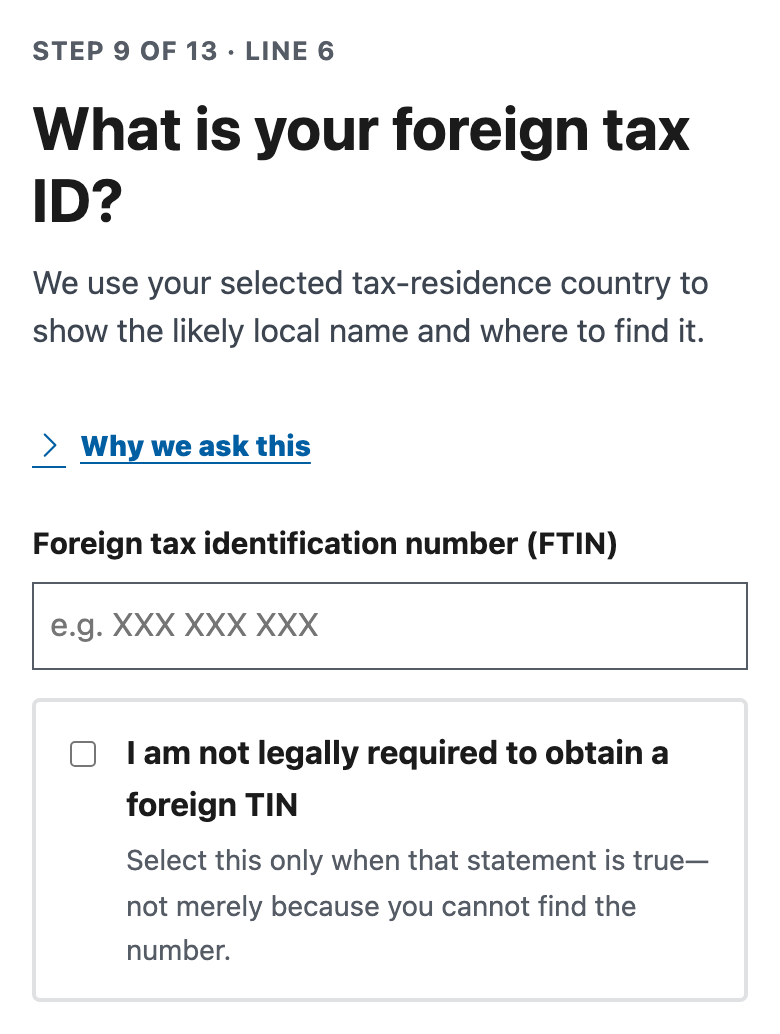
The foreign tax ID step in our W-8BEN interview, with Canada selected earlier as the example tax-residence country. No tax number has been entered.
Open full-size screenshotOpen full-size screenshot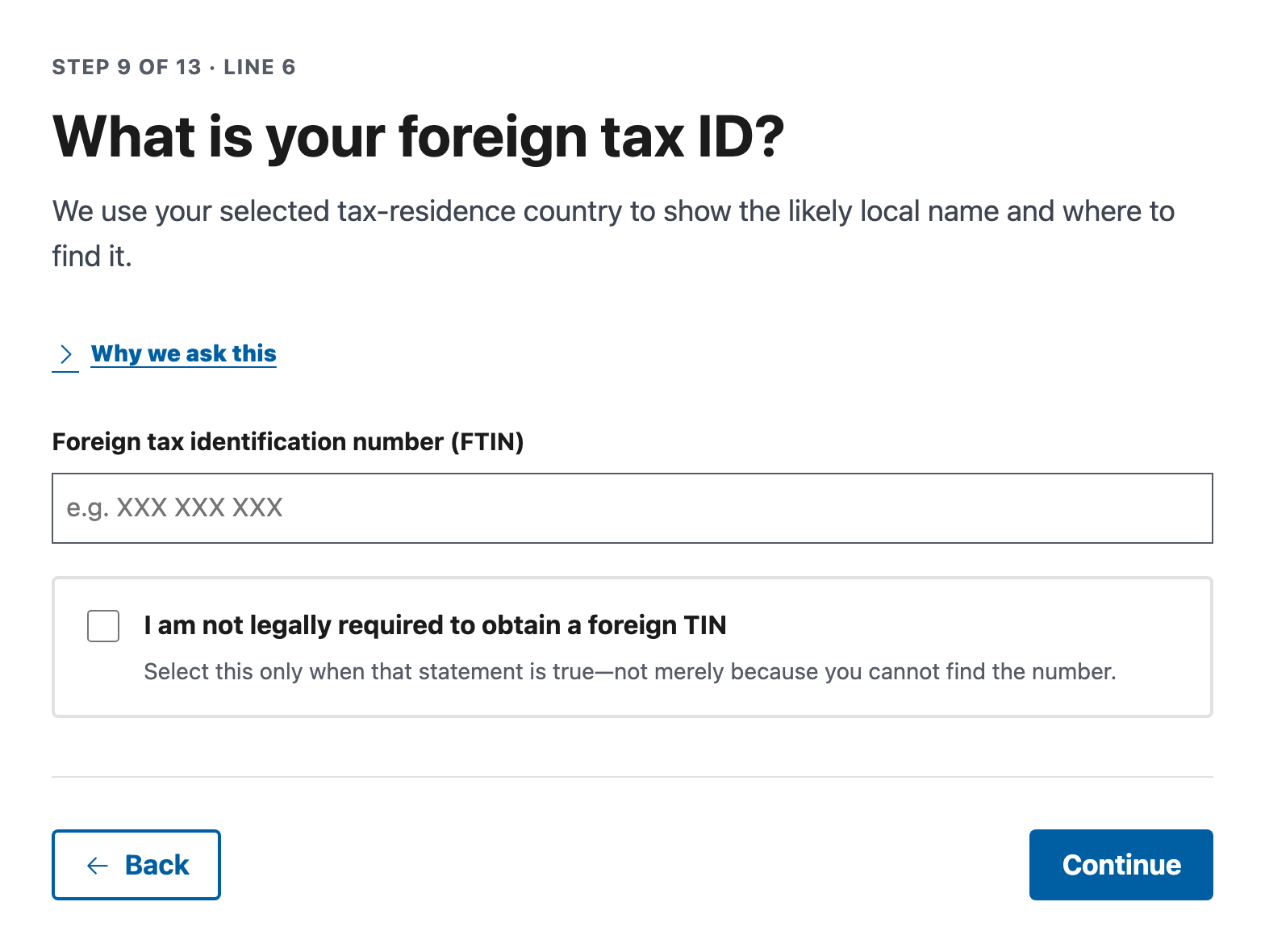
- Enter your foreign TIN in this field
Open “Why we ask this” for the country-specific guidance. The U.S. taxpayer ID question is a separate step.
Back to screenshot - Read the exemption before selecting it
The checkbox says “I am not legally required to obtain a foreign TIN.” It is a separate statement, not a shortcut for a missing number.
Back to screenshot
What platforms check
A withholding agent may validate the number against its own rules before accepting a treaty claim. Two patterns are common.
- Character set. Google’s tax tool accepts only letters, digits, spaces, hyphens, and ampersands. Numbers written with dots, such as a Brazilian CPF or a Swiss AHV number, should be entered without the punctuation.
- Length checks. Some platforms compare the length of the number with the format they expect for the country you selected. A Philippine TIN entered with its three-digit branch code, or a UK National Insurance number with spaces, can fail that check even though the number is real. Try the number without spaces and separators first.
Entering a number that belongs to someone else, or a number from a country other than your Line 9 treaty country, is the mistake that causes a form to be declined outright. The country on Line 3, the treaty country on Line 9, and the authority that issued the Line 6 number should all match.
Worked examples
Amira in Cairo earns royalties from a U.S. publisher and wants the 15% treaty rate for Egypt. She enters her nine-digit tax registration number on Line 6a, Egypt on Line 9, and leaves Line 5 blank. She does not need an ITIN.
Tom in Sydney holds shares through a U.S. broker. Australia is on the IRS list, so the broker cannot insist on a foreign TIN. Tom leaves Line 6a blank, does not tick 6b, and the broker accepts the form with his treaty claim.
Layla in Dubai signs a W-8BEN for a U.S. client. The UAE issues no personal income tax number, so she leaves 6a blank, ticks 6b, and writes “UAE does not issue TINs to individuals” where the client’s form allows it. She claims no treaty rate because the UAE has no U.S. income tax treaty.
Ravi in Bengaluru submits a W-8BEN in YouTube’s tax tool and claims the India treaty. He enters his PAN, ten characters with no spaces. Aadhaar would be rejected because it is an identity number, not a tax number.
Frequently asked questions
What is a foreign tax identifying number on Form W-8BEN?
It is the number your own country's tax authority uses to identify you as a taxpayer, entered on Line 6a. The IRS instructions describe it as a tax identifying number issued to you by your jurisdiction of tax residence. It is not a U.S. number, and you do not apply to the IRS for it.
Do I need a U.S. ITIN if I have a foreign TIN?
No. The instructions say you must generally provide an ITIN for a treaty claim only if you do not provide a foreign TIN on Line 6. A valid foreign TIN is the normal way for a non-U.S. individual to claim a treaty rate.
What is my foreign tax identifying number in the UK?
Either your Unique Taxpayer Reference, which is ten digits and appears on HMRC letters, or your National Insurance number, which is two letters, six digits, and one letter. Google lists both as acceptable. A UK company uses its company UTR, not its Companies House number.
What is the foreign tax identifying number for India?
Your Permanent Account Number (PAN), ten characters made of five letters, four digits, and one letter. Aadhaar is not accepted because it is an identity number rather than a tax number.
What is the foreign tax identifying number for Canada?
For an individual it is the nine-digit Social Insurance Number. A Canadian company enters its Business Number. The SIN appears on your notice of assessment and in CRA My Account.
Can I leave Line 6 blank on Form W-8BEN?
Yes in three cases: you are not claiming a treaty benefit and the payer is not a financial institution; your jurisdiction is on the IRS list of jurisdictions that do not issue foreign TINs; or you are not legally required to obtain a TIN, in which case you tick Line 6b. Leaving it blank simply because you cannot find the number is not one of the cases.
What does the checkbox on Line 6b mean?
It certifies that you are not legally required to obtain a tax identification number in your jurisdiction of residence, including because the jurisdiction does not issue them. The instructions allow a brief explanation alongside it. Residents of countries with no personal income tax, such as the UAE, are the usual example.
Why did a platform reject my foreign TIN?
Usually because of format, not validity. Remove spaces, dots, and hyphens, and check that the country you selected matches the authority that issued the number. Google's tool, for example, accepts only letters, digits, spaces, hyphens, and ampersands, and some platforms compare the length with what they expect for your country.
Important: This guide provides general educational information, not tax or legal advice. It does not confirm which number a specific payer will accept. Check the current IRS instructions and the payer’s own guidance.