Use case: Freelancers
Upwork and Fiverr tax information for non-U.S. freelancers: the W-8BEN, and the PDF your direct clients need
Upwork's tax information page is Form W-8BEN broken into three sections. Fiverr only asks whether you are a U.S. person. Your direct U.S. clients want the actual PDF, signed. This guide covers all three.
If you freelance from outside the United States, three different people may ask you for “tax information”. Upwork asks on a page of its own. Fiverr asks one question when you publish a Gig. And a direct U.S. client, with no marketplace in between, sends you a blank IRS form and waits for it back.
All three are asking the same thing. They want a certificate that you are not a U.S. person, so they can pay you without U.S. withholding and without sending you a year-end 1099. For an individual, that certificate is Form W-8BEN. This guide shows where each marketplace collects it and how their fields map to the form. It explains why most freelancers never need a treaty claim, and what a direct client needs to see on a signed PDF. It is educational information, not tax advice.
Why marketplaces ask for it
Upwork explains the reason plainly. It is based in the United States, so it “requires that you complete either a W-9 or a W-8BEN or W-8BEN-E form” to meet IRS reporting rules. The W-9 is for U.S. persons. The W-8 forms are for everyone else.
Two things follow from that.
- The form is about status, not about tax you owe. Upwork says it uses the form “to confirm that you’re not a U.S. Person and that we’re not required to withhold taxes from your earnings”. With a valid form on file, Upwork “is not required to withhold U.S. taxes from your earnings”.
- No W-8BEN means no 1099, but it also means no payout. Upwork files Form 1099-K only for freelancers who are U.S. persons. Non-U.S. freelancers get no U.S. tax statement at all. They also cannot withdraw until the form is done. More on that below.
Upwork adds one warning worth reading twice. If the form is missing, Upwork “may be required to withhold up to 30% of your future earnings on Upwork and send it to the IRS”. And: “We cannot give you a refund on taxes that we withhold and send to the IRS, even if you complete the form later.”
Where the form lives on Upwork
Upwork’s help centre gives this path for individuals, corporations, and partnerships:
- Go to Manage finances, then Tax information.
- Complete the Tax residence section with your tax address, which must be outside the U.S.
- Complete Taxpayer identification: confirm you are a non-U.S. taxpayer, then enter your legal name, tax classification, date of birth, and country of citizenship.
- Complete Tax identification number with the number you use for tax reporting at home.
- Read the certification and the statement of source, sign electronically with your legal name, and tick the confirmation box.
Each section shows Not completed until you finish it, then Completed. Upwork states that you “must complete one before you can withdraw earnings” and that you “can withdraw funds as soon as you complete” it. Past and current forms sit under Manage finances, then Tax forms.
One case leaves Upwork’s built-in flow. It covers treaty claims and entities that are neither corporations nor partnerships. For these, Upwork says “you can’t complete the full form on Upwork”. You select “other entity type or claiming treaty benefits” and “submit the completed IRS form directly to the Upwork tax team”. That is the official PDF, not a web form.
Where the form lives on Fiverr
Here is the surprise for anyone searching “fiverr w8ben”: Fiverr does not collect a W-8BEN from non-U.S. sellers at all. Its help centre has a page on W-9 collection and none on W-8. The rule it states is that all freelancers “will have to declare if they are a U.S. person. If so, they will have to go through the W-9 process.” For everyone else: “If you declared that you were not a ‘U.S. person’, you’re finished” and “no further actions are required on your side.”
The declaration appears in two places.
- When you publish a Gig. Fiverr’s Gig guide says: “Before you publish, indicate whether you’re a US person. US-based freelancers are also required to submit a W-9 form.”
- Later, on the Earnings page. Go to My Business, then Earnings, open the Financial documents tab, and click Update your declaration. Select No and click Save.
Why the lighter touch? Fiverr’s vendor page lists the company as Fiverr International Ltd., incorporated in Tel Aviv. It is not a U.S. payer in the way Upwork is. So if you sell only on Fiverr, you have no W-8BEN to file there. You will still need one the first time a direct U.S. client asks.
Before you open either page
- Your legal name, exactly as on your ID. Upwork signs the form with it, and it must match the payout account name.
- A street address outside the United States. The IRS instructions for Line 3 rule out “a post office box, or an address used solely for mailing purposes”. Upwork’s tax address “must be outside the U.S.” Keep it updated if you move.
- Your home-country tax number. Upwork gives India’s PAN and national ID numbers as examples. If you have none, Upwork’s advice is to ask your local tax authority for one. The IRS requires a foreign TIN on Line 6a unless an exception applies.
- Your date of birth and country of citizenship. Both are required for individuals.
- An honest answer to one question. Do you do any of the work while physically in the United States? Upwork’s statement of source has you confirm “that you’re not doing work within the U.S.” If the answer is yes, read the treaty section below before signing anything.
Prepare and review your answers in our tool
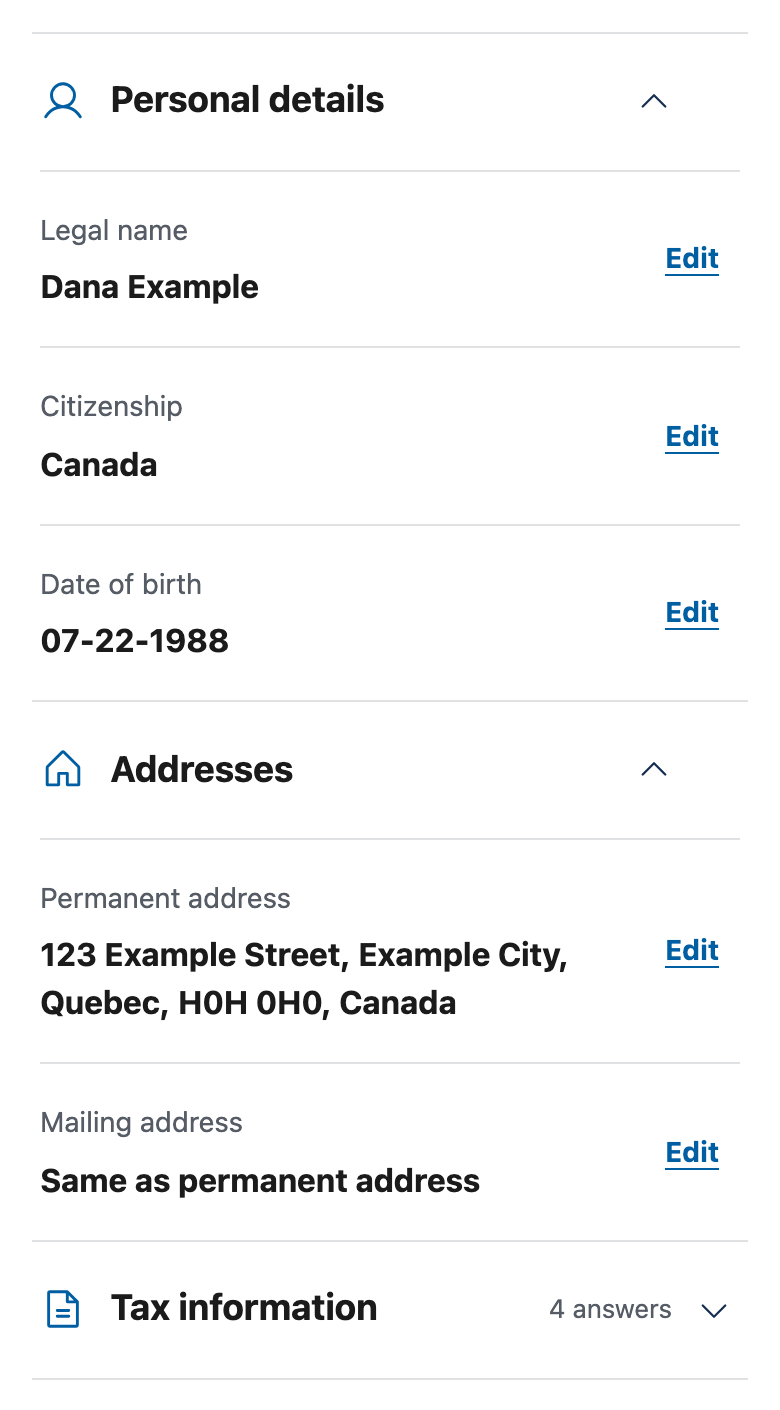
The answer-review panel in our W-8BEN interview, using the fictional Dana Example fixture. This is our preparation tool; a payer’s tax portal has its own screens and submission process.
Open full-size screenshotOpen full-size screenshot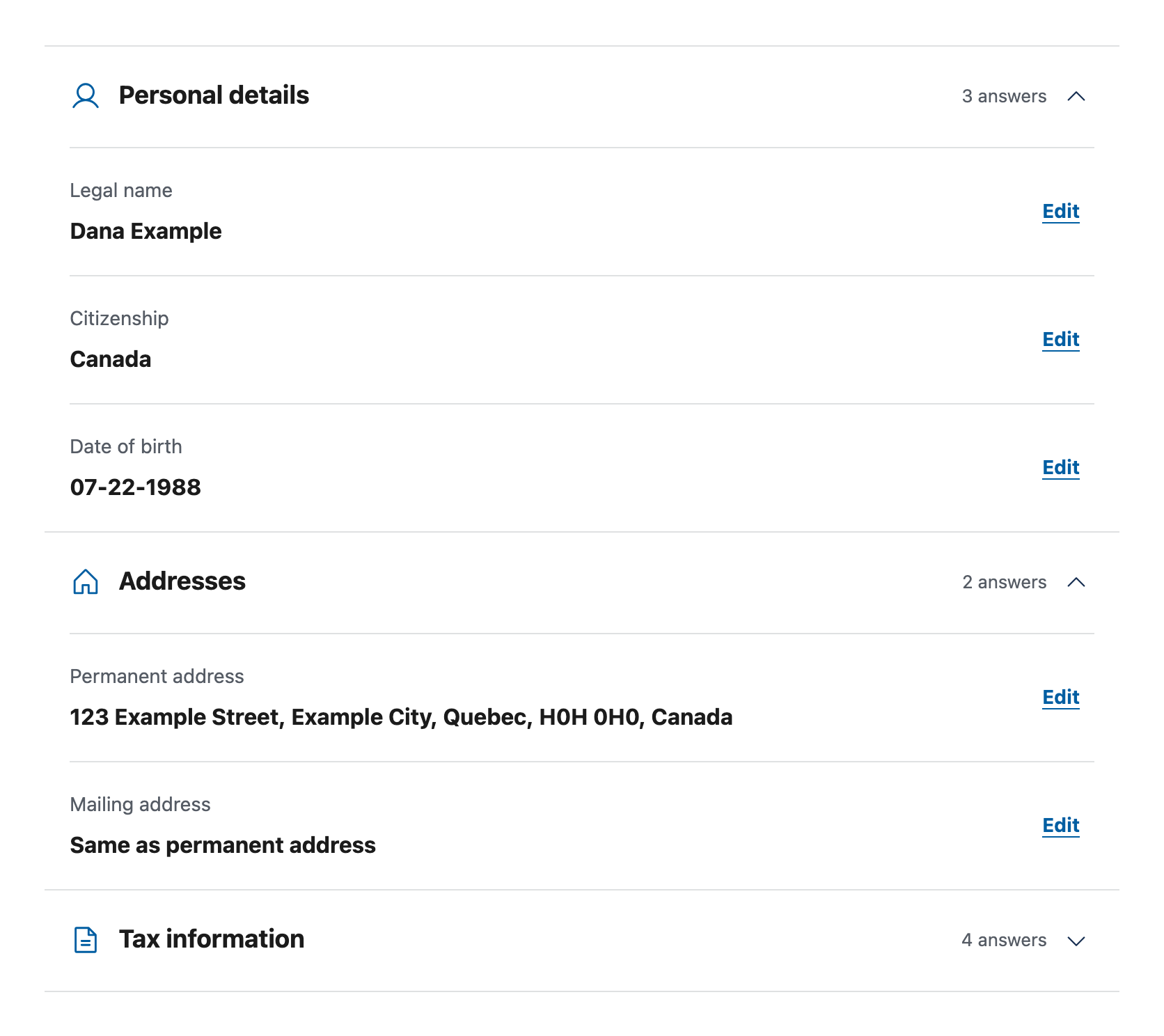
- Review the answers in each section
Check Personal details and Addresses, then expand Tax information to review the remaining answers.
Back to screenshot - Use Edit to correct an answer
Each Edit button returns to that question so you can correct it before continuing. Completing and reviewing the answers is free; signing and downloading come after payment.
Back to screenshot
Marketplace fields, mapped to Form W-8BEN
Upwork’s page never shows line numbers, and Fiverr’s declaration is a single yes or no. This table connects each field to the official form. That way your marketplace answers and the PDF you hand a direct client tell the same story.
| Marketplace field | What it becomes | What to enter |
|---|---|---|
| Upwork: “Confirm you’re a non-U.S. taxpayer” | Chooses W-8BEN over W-9 | Answer as a non-U.S. person. U.S. citizens and green-card holders are U.S. persons and file W-9 instead. |
| Upwork: Federal tax classification (individual, corporation, partnership) | Chooses W-8BEN (individual) or W-8BEN-E (entity) | Pick individual if you are paid personally. A company payee needs W-8BEN-E. |
| Upwork: Legal name | W-8BEN Line 1 | Your full legal name, no business name or handle. |
| Upwork: Country of citizenship | W-8BEN Line 2 | Citizenship, which can differ from where you pay tax. |
| Upwork: Tax residence address | W-8BEN Line 3 | Street address in the country where you are tax resident. No PO box, nothing “in care of”. |
| Not asked by either marketplace | W-8BEN Line 4 (mailing address) | Only if your mail goes somewhere else. Usually blank. |
| Not asked by either marketplace | W-8BEN Line 5 (U.S. TIN) | Blank for almost every freelancer. You do not need an SSN or ITIN. |
| Upwork: Tax identification number | W-8BEN Line 6a | Your home-country tax number: PAN in India, NIF in Spain, UTR in the UK, and so on. |
| Not asked by either marketplace | W-8BEN Line 7 (reference number) | Optional. A direct client may ask you to write their vendor or contract number here. |
| Upwork: Date of birth | W-8BEN Line 8 | Required for individuals. |
| Upwork: “Claiming treaty benefits” path | W-8BEN Lines 9 and 10 | Most freelancers leave both blank. See the next section. |
| Upwork: Statement of source | Not a W-8BEN line | Confirms your work is done outside the U.S. It is why Lines 9 and 10 can stay empty. |
| Upwork: Electronic signature, date, confirmation box, affidavit | W-8BEN Part III | Sign with your legal name. The date defaults to the day you sign. Leave the capacity field empty when signing for yourself. |
| Fiverr: “Are you a US person?” | The whole form, in effect | Answer No. Fiverr asks for nothing else from non-U.S. sellers. |
The treaty question for services
Creators on YouTube need a treaty claim because royalties from U.S. viewers are U.S.-source income. Freelance services work differently, and this is the part most guides get wrong.
The IRS rule is about place, not payer. In its words: “The place, where the personal services are performed, generally determines the source of the personal service income, regardless of where the contract was made, or the place of payment, or the residence of the payer.” And: “A nonresident alien (NRA) generally is subject to U.S. income tax only on income from U.S. sources.”
So if you design, write, or code from your home in Manila or Lisbon, the fee is foreign-source income even when the client is in Ohio. There is nothing to reduce, so there is no treaty article to cite. That is why Upwork’s standard flow has no treaty step at all, and why most freelancers leave Line 9 and Line 10 blank. The W-8BEN’s job in that case is only to certify that you are not a U.S. person.
The picture changes if you physically perform the work in the United States. The W-8BEN instructions say not to use the form if you are “a nonresident alien individual who claims exemption from withholding on compensation for independent or dependent personal services performed in the United States. Instead, provide Form 8233 or Form W-4.” Income that is effectively connected with a U.S. trade or business points to Form W-8ECI instead.
| Comparison | Marketplace payout (Upwork, Fiverr) | Direct U.S. client, work done abroad | Work physically performed in the U.S. |
|---|---|---|---|
| Where the work happens | Your home country | Your home country | Inside the United States, even briefly |
| Source of the income | Foreign-source | Foreign-source | U.S.-source for the days worked there |
| Form to give | W-8BEN (Upwork) or a U.S.-person declaration (Fiverr) | W-8BEN, signed PDF | Form 8233 to claim a treaty exemption, or W-8ECI for effectively connected income |
| Lines 9 and 10 | Blank | Blank | Not applicable; the treaty claim goes on Form 8233 |
| U.S. withholding to expect | None with a valid form on file, per Upwork | None expected on foreign-source income | Withholding applies unless an exemption is claimed on Form 8233 |
| Who you give it to | The marketplace, in its settings | The client's finance team, never the IRS | The client, who files Form 8233 with the IRS |
If you split your year, the IRS sourcing page allocates pay by where the days were worked. That is a case for a tax adviser, not a web form.
The direct-client case: what a signed PDF must contain
Marketplaces build the form for you. A direct client does not. Their accounts team usually emails the IRS PDF, or a link to it, and asks for it back before the first invoice is paid. The IRS instructions back them up: “Give Form W-8BEN to the person requesting it before the payment is made to you.”
A PDF a client can accept has these properties.
- Every required line filled. Lines 1, 2, 3, 6a (or the reason it is missing), and 8 for an individual. Blank required lines are the most common reason a form bounces back.
- A signature and a date. The instructions say the form “must be signed and dated by the beneficial owner”. A typed name in the signature box with no date is not a signed form.
- The certification left intact. Do not strike through or edit the Part III text.
- Lines 9 and 10 blank unless the work was performed in the United States, in which case you are probably on the wrong form anyway.
- An address that matches your invoices. Finance teams compare the two.
Deliver it as a PDF, not a photo. Send it by whatever channel the client uses for vendor documents: email, a supplier portal, or a payments platform that has its own upload slot. Never send it to the IRS. The instructions are explicit: “Do not send Form W-8BEN to the IRS. Instead, give it to the person who is requesting it from you.”
How often will clients ask again? The IRS validity rule is three calendar years, explained in the timeline below. Some finance teams also ask for a fresh copy when they onboard a new vendor system or when your address changes. Keeping a signed PDF on hand makes each request a one-minute reply.
Freelancers invoicing through a company
Do your invoices come from a limited company, an OÜ, a Pty Ltd, or another entity separate from you? Then the client needs Form W-8BEN-E, not W-8BEN. On Upwork, pick corporation or partnership as your classification. The same tax information page then produces the entity version. For a direct client, our W-8BEN-E interview handles the entity questions, including the limitation-on-benefits section that trips most people up. A sole trader with no separate legal entity stays on W-8BEN.
How long the form lasts
Life of a freelancer's W-8BEN
The IRS rule applies whether the form sits with Upwork or in a client's vendor file: it stays valid until the last day of the third calendar year after the year you sign, unless something on it changes first.
You sign the form
On Upwork, withdrawals open as soon as the three sections show Completed. With a direct client, the signed PDF goes into their vendor file before the first payment.
You move, change your name, or start working inside the U.S.
The IRS instructions require you to notify the payer within 30 days of a change in circumstances and file a new form. On Upwork, edit the section with the pencil icon, review, and re-sign.
Upwork asks you to refresh
Upwork says it may ask you to update the form from time to time even if nothing has changed, because the form needs to be refreshed every three years to stay valid.
December 31, 2029
A form signed in 2026 expires at the end of the third full calendar year after it. Sign a fresh one for each marketplace and each direct client before then.
Important: These dates assume a signature in 2026 and no change in circumstances. A new country of residence, a new legal name, or work performed in the United States ends the form's validity early.
Worked examples
Priya, a UX designer in Pune, works only on Upwork. She opens Manage finances, then Tax information, and completes the three sections with her PAN as the tax ID. She picks individual as her classification and signs. There is no treaty step because she does all the work from India. Her withdrawals open the same day.
Tomasz, a developer in Krakow, lands a direct client in Texas. The client’s bookkeeper emails a blank W-8BEN and says payment waits until it is back. Tomasz fills Lines 1, 2, 3, 6a, and 8 and leaves 5, 9, and 10 blank. He signs and dates Part III and returns a PDF. The bookkeeper files it and pays the invoice with no withholding.
Mariana, a translator in Buenos Aires, sells on Fiverr and to one direct client. On Fiverr she answers No to the U.S. person question when she publishes her Gig, and that is all Fiverr wants. Her direct client still needs the PDF, so she prepares one W-8BEN and keeps it for the next client too.
Kwame, a video editor in Accra, will spend six weeks editing on site in Los Angeles. The income for those weeks is U.S.-source. His W-8BEN covers the remote work, but for the on-site weeks the client asks about Form 8233. Because this splits his year, he takes the question to a tax adviser.
Frequently asked questions
Does Fiverr ask non-U.S. sellers for a W-8BEN?
No. Fiverr's help centre says all freelancers must declare whether they are a U.S. person, and that if you declared you are not, you are finished and no further action is required. The declaration appears when you publish a Gig and can be updated under My Business, Earnings, Financial documents. Only U.S. persons complete a W-9 there.
Where is the tax information page on Upwork?
Go to Manage finances, then Tax information. It has three sections: Tax residence, Taxpayer identification, and Tax identification number. Each shows Not completed until you finish it. Your current and past forms are listed under Manage finances, then Tax forms.
What happens if I do not complete the W-8BEN on Upwork?
Upwork states that you will not be able to withdraw earnings, and that it may be required to withhold up to 30% of your future earnings and send it to the IRS. Upwork also says it cannot refund tax it has already sent to the IRS, even if you complete the form later.
Do I need to claim a tax treaty for freelance work on Upwork or Fiverr?
Usually not. The IRS sources personal service income by where the work is performed, not where the client is. Work done from your home country is foreign-source income, so there is nothing for a treaty to reduce and Lines 9 and 10 stay blank. Upwork's standard flow has no treaty step; treaty claims go to its tax team on the IRS PDF.
My direct U.S. client sent me a W-8BEN. Do I file it with the IRS?
No. The IRS instructions say not to send Form W-8BEN to the IRS but to give it to the person requesting it, before the payment is made. Return a complete, signed, dated PDF to the client's finance team and keep a copy for yourself.
Do I need a U.S. tax number such as an SSN or ITIN?
No. Line 5 stays blank for almost every freelancer. The form asks for your home-country tax number on Line 6a, such as India's PAN or the UK's UTR. Upwork's tax ID field is that same number. If you have none, Upwork's advice is to ask your local tax authority how to get one.
How long does a freelancer's W-8BEN last?
Until the last day of the third calendar year after the year you sign it, so a form signed in 2026 lasts until December 31, 2029. A change of address, name, or country ends it early, and the IRS requires a new form within 30 days of such a change. Upwork says it refreshes the form every three years and will prompt you.
I invoice through my own company. Which form do I give?
Form W-8BEN-E, the entity version. On Upwork, choose corporation or partnership as your classification. For a direct client, prepare the W-8BEN-E PDF, which includes an entity classification and a limitation-on-benefits section that the individual form does not have. A sole trader with no separate legal entity stays on W-8BEN.