Completing Form W-8BEN
W-8BEN treaty benefits: what Line 9 and Line 10 ask, and when Line 10 is required
Line 9 is a country. Line 10 is an article, a rate, and an income type, and most people should leave it empty. This guide explains which group you are in and what to write if you are in the second.
A tax treaty is an agreement between the United States and another country that, among other things, lowers the tax the U.S. withholds on payments to residents of that country. For a non-U.S. individual, Form W-8BEN is the only place to claim that lower rate, and Part II is where the claim is made.
The claim has two lines. Line 9 names the treaty country. Line 10 cites the specific article and rate, and the IRS requires it only in defined situations. Getting the split right avoids two opposite mistakes: leaving Line 10 blank when a platform needs it, and filling it with guesses when the instructions say it is unnecessary.
This guide is educational information, not tax advice. Treaty eligibility depends on residence, beneficial ownership, and sometimes limitation-on- benefits rules that this page does not evaluate.
What a treaty claim changes
Without a form on file, a U.S. payer withholds 30% of U.S.-source income paid to a non-U.S. individual, and in some cases applies backup withholding to everything. With a W-8BEN and no treaty claim, the rate is still 30%, but only on U.S.-source income. With a valid treaty claim, the rate drops to the figure in the treaty, which for royalties is often zero.
| Comparison | No W-8BEN on file | W-8BEN, Part II blank | W-8BEN with Line 9 (and Line 10 where required) |
|---|---|---|---|
| Withholding rate | 30%, or backup withholding on some platforms | 30% | 0% |
| Withheld | $300 or more | $300 | $0 |
| Paid to you | $700 or less | $700 | $1,000 |
| How to recover the difference later | U.S. tax return | U.S. tax return | Nothing to recover |
The treaty does not make the income tax-free. It moves the taxing right to your home country, where you report the income as usual.
Line 9: the treaty country
Line 9 reads “I certify that the beneficial owner is a resident of ______ within the meaning of the income tax treaty between the United States and that country.” You write the country name.
Three conditions must all be true.
- A treaty exists and is in force. The IRS keeps the list linked in the sources. Countries with no treaty include Brazil, Argentina, Colombia, Singapore, Hong Kong, Malaysia, Nigeria, Kenya, the UAE, and Vietnam. Hungary’s treaty has been terminated. Russia’s and Belarus’s are partially suspended, including the royalty and dividend articles.
- You are a resident of that country under the treaty. For most people that means the country where you live and pay tax. Line 3 must show an address there.
- You are the beneficial owner. You receive the income for yourself, not on behalf of someone else.
If any of the three fails, leave Part II blank. The form is still worth submitting, because 30% of U.S.-source income beats backup withholding on everything.
Keep these questions separate
Three locations.
Three different questions.

- Citizenship
- Which country are you a citizen of?
- Treaty residence
- Where do you qualify as a resident under the treaty’s rules?
- Payer’s location
- Where is the company or platform paying you based?
Line 10: when the IRS requires it
The instructions are specific. Line 10 “must be used only if you are claiming treaty benefits that require that you meet conditions not covered by the representations you make on line 9”. They then list the cases.
- Royalties, when the treaty sets different rates for different types. The Canada treaty, for example, exempts copyright royalties but taxes film and television royalties at 10%. A Canadian author needs Line 10 to say which one applies. Where a treaty has a single royalty rate, the instructions do not require the line, but platforms often ask for it anyway.
- Foreign students, trainees, and researchers claiming an exemption on scholarship or fellowship income. The instructions say these claimants “must complete this line”.
- Business profits or gains not attributable to a permanent establishment. Also mandatory.
- Remittance-based provisions, where the treaty benefit depends on the income being remitted to the treaty country.
What is not on the list: portfolio dividends and interest. A non-U.S. investor at a broker normally completes Line 9 and stops. The broker applies the treaty dividend rate from Line 9 alone.
Do I need Line 10?
A summary of the instructions, not a substitute for them. Follow the branches from the treaty to the income type.
Does your country have an income tax treaty with the United States that is in force?
Leave Part II blank
Complete Part I and Part III only. The form still certifies that you are not a U.S. person, and the statutory 30% rate applies to U.S.-source income.
What kind of income will the payer make?
Complete Line 9 only
Portfolio dividends and interest take the treaty rate on residence alone. Enter the country on Line 9 and leave Line 10 blank unless the broker asks for it.
Does the treaty set different rates for different types of royalty?
Complete Line 9 and Line 10
Enter the treaty country on Line 9, then the article and paragraph, the rate, the income type, and a short explanation on Line 10.
What to write on Line 10
The line has four blanks, in this order.
- Article and paragraph. The provision in the treaty that sets the rate, such as “Article 12, paragraph 2” or, for Canada, “Article XII, paragraph 3”. The royalty table below gives the citation for each country as printed in IRS Tax Treaty Table 1.
- Rate. The percentage from the treaty, such as “0” or “10”. Not the 30% statutory rate.
- Type of income. In words: “copyright royalties”, “royalties for the use of software”, “scholarship income”.
- Explanation. Why you meet the conditions. One sentence is enough: “The beneficial owner is a resident of Canada and the royalties are for copyrights of literary works.”
Platforms that generate the form for you, such as Google’s tax tool and Amazon’s tax interview, fill these blanks from the income type you select. That is why the YouTube and KDP guides on this site tell you to expect “Other Copyright Royalties” rather than a bare article number.
Entering the details in our tool
If you select a treaty claim in our W-8BEN interview, the next screen asks for the details separately. Use the position you have confirmed; the tool does not choose a treaty rate for you.
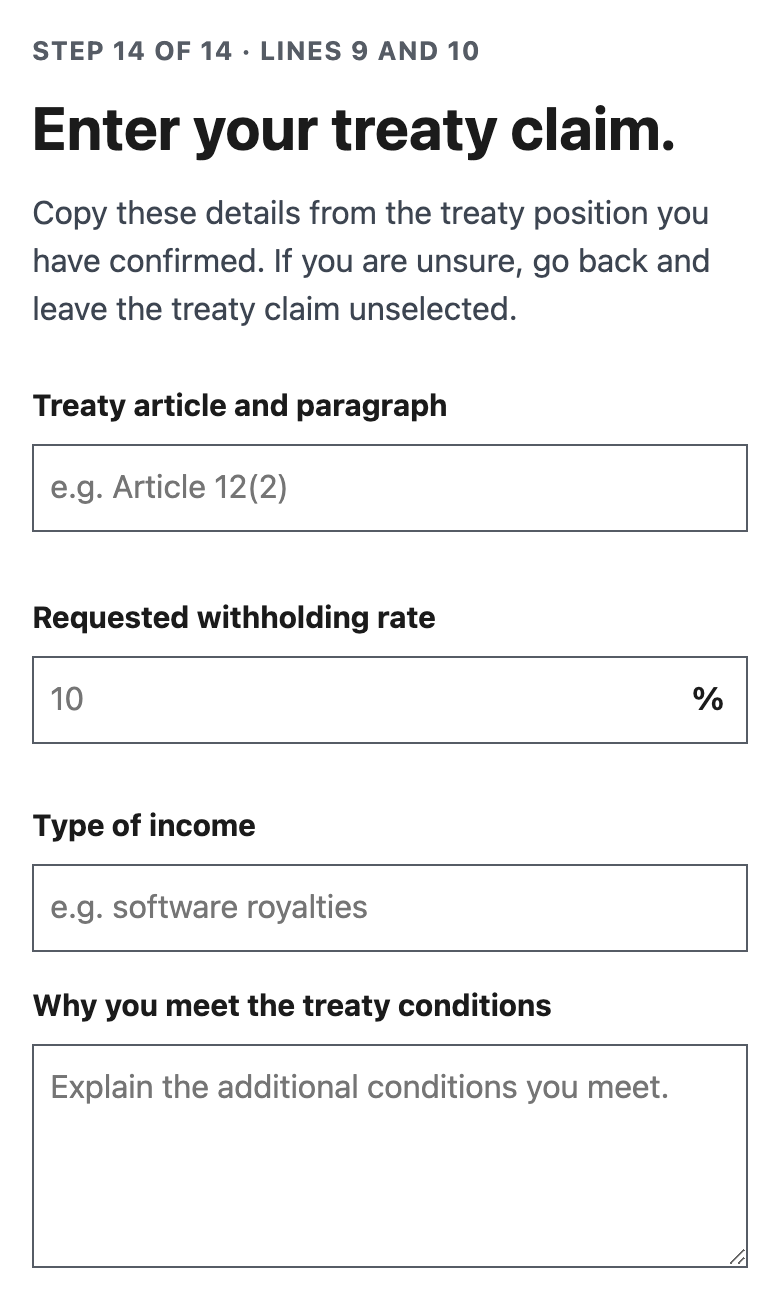
The treaty-details step in our W-8BEN interview, shown after selecting a treaty claim. These fields are deliberately empty; this screenshot does not recommend a treaty position or rate.
Open full-size screenshotOpen full-size screenshot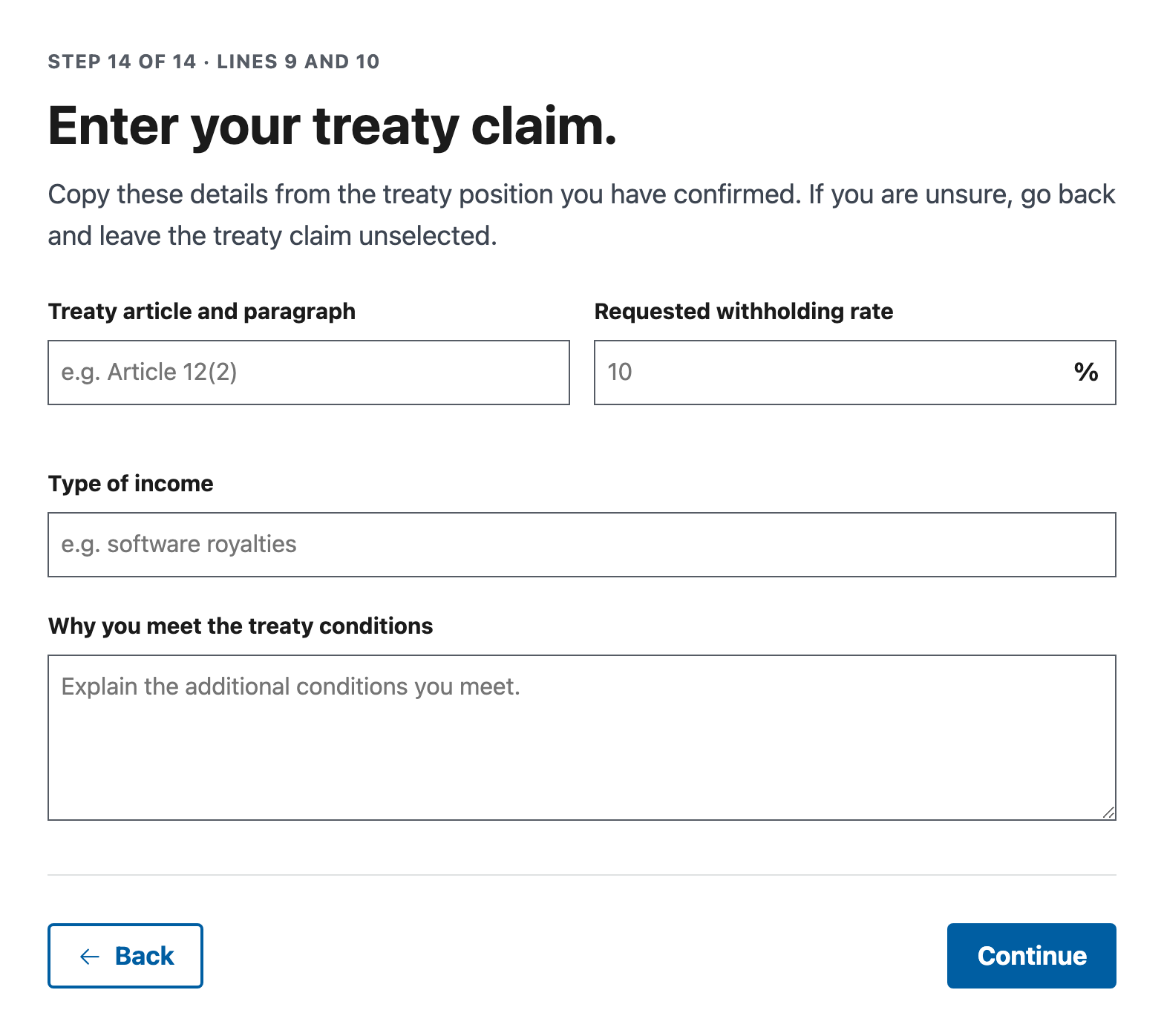
- Article and rate go in separate fields
Enter the confirmed article and paragraph, then the requested percentage. The percent symbol is already shown beside the rate field.
Back to screenshot - Name the income covered by the claim
The Type of income field describes the income for this treaty position.
Back to screenshot - Explain the conditions you meet
Use the explanation field for the additional conditions supporting the claim. If you have not confirmed the position, go back and leave the treaty claim unselected.
Back to screenshot
Royalty rates and articles by country
The selector shows the withholding rate on copyright royalties and on film and television royalties for each treaty country, with the article citation to use on Line 10.
Withholding rates on U.S.-source royalties by treaty country
Transcribed from IRS Tax Treaty Table 1, columns for film and television royalties (income code 11) and copyright royalties (income code 12).
Your selection stays in this browser tab and is not sent anywhere.
Show the full table for every treaty country
| Country | Copyright royalties | Film and TV royalties | Treaty article |
|---|---|---|---|
| Armenia | 0% | 0% | III(1)(a) (U.S.–U.S.S.R. treaty) |
| Australia | 5% | 5% | 12(2) / P8 |
| Austria | 0% | 10% | 12(1), (2) |
| Azerbaijan | 0% | 0% | III(1)(a) (U.S.–U.S.S.R. treaty) |
| Bangladesh | 10% | 10% | 12(2) |
| Barbados | 5% | 5% | 12(2) / 1PV; 2PII(6) No treaty benefit if the recipient is under a special low-tax regime (Table 1 footnote rr). |
| Belarus | 30% | 30% | Treaty partially suspended The IRS lists the U.S.–U.S.S.R. treaty as partially suspended for Belarus. Treat the rate as 30% unless a tax adviser confirms otherwise. |
| Belgium | 0% | 0% | 12(1) |
| Bulgaria | 5% | 5% | 12(2) / P5(7) |
| Canada | 0% | 10% | XII(2), (3) / 5P7(1) |
| Chile | 10% | 10% | 12(1)–(6) |
| China | 10% | 10% | 11(2) |
| Cyprus | 0% | 0% | 14(1) |
| Czech Republic | 0% | 0% | 12(2) |
| Denmark | 0% | 0% | 12(1) |
| Egypt | 15% | Not covered by the royalty article | 13(1) |
| Estonia | 10% | 10% | 12(2) |
| Finland | 0% | 0% | 12(1) |
| France | 0% | 0% | 12(1) / 2PIII |
| Georgia | 0% | 0% | III(1)(a) (U.S.–U.S.S.R. treaty) |
| Germany | 0% | 0% | 12(1) |
| Greece | 0% | 30% | VII |
| Hungary | 30% | 30% | Treaty terminated The IRS lists the U.S.–Hungary treaty as terminated. The statutory 30% rate applies. |
| Iceland | 0% | 5% | 12(1), (2) |
| India | 15% | 15% | 12(2)–(4) |
| Indonesia | 10% | 10% | 13(2) / P34 |
| Ireland | 0% | 0% | 12(1) |
| Israel | 10% | 10% | 14(1) |
| Italy | 0% | 8% | 12(2) Italy taxes software royalties at the industrial-equipment rate rather than the copyright rate (Table 1 footnote tt). |
| Jamaica | 10% | 10% | 12(2) |
| Japan | 0% | 0% | 12(1) |
| Kazakhstan | 10% | 10% | 12(2) |
| Kyrgyzstan | 0% | 0% | III(1)(a) (U.S.–U.S.S.R. treaty) |
| Latvia | 10% | 10% | 12(2) |
| Lithuania | 10% | 10% | 12(2) |
| Luxembourg | 0% | 0% | 13(1) |
| Malta | 10% | 10% | 12(2) |
| Mexico | 10% | 10% | 12(2) |
| Moldova | 0% | 0% | III(1)(a) (U.S.–U.S.S.R. treaty) |
| Morocco | 10% | 10% | 12(2) |
| Netherlands | 0% | 0% | 13(1) |
| New Zealand | 5% | 5% | 12(2) / PVIII |
| Norway | 0% | Not covered by the royalty article | 10(1) |
| Pakistan | 0% | Not covered by the royalty article | VIII(1) Payments for TV broadcasting rights fall under the royalty article, but rental income from motion picture films does not (Table 1 footnote u). |
| Philippines | 15% | 15% | 13(2) The Philippine domestic rate differs from the U.S. treaty rate (Table 1 footnote vv). |
| Poland | 10% | 10% | 13(2) |
| Portugal | 10% | 10% | 13(2) |
| Romania | 10% | 10% | 12(2) |
| Russia | 30% | 30% | Treaty partially suspended The IRS lists the U.S.–Russia treaty as partially suspended, and the suspension covers the royalties article. Treat the rate as 30%. |
| Slovak Republic | 0% | 0% | 12(2) |
| Slovenia | 5% | 5% | 12(1) |
| South Africa | 0% | 0% | 12(1) |
| South Korea | 10% | 10% | 14(1) |
| Spain | 0% | 0% | 12(1) / PVI |
| Sri Lanka | 10% | 10% | 12(2) |
| Sweden | 0% | 0% | 12(1) |
| Switzerland | 0% | Not covered by the royalty article | 12(1) |
| Tajikistan | 0% | 0% | III(1)(a) (U.S.–U.S.S.R. treaty) |
| Thailand | 5% | 5% | 12(2) |
| Trinidad and Tobago | 0% | Not covered by the royalty article | 14(1) 15% for copyrights of scientific work (Table 1 footnote cc). |
| Tunisia | 15% | 15% | 12(2)–(3) |
| Turkey | 10% | 10% | 12(2) |
| Turkmenistan | 0% | 0% | III(1)(a) (U.S.–U.S.S.R. treaty) |
| Ukraine | 10% | 10% | 12(2) |
| United Kingdom | 0% | 0% | 12(1) |
| Uzbekistan | 0% | 0% | III(1)(a) (U.S.–U.S.S.R. treaty) |
| Venezuela | 10% | 10% | 12(2) |
| Any other country | 30% | 30% | No treaty. Common examples: Argentina, Brazil, Colombia, Ghana, Hong Kong, Kenya, Malaysia, Nigeria, Peru, Saudi Arabia, Singapore, Taiwan, United Arab Emirates, Vietnam. |
Read before relying on a rate: figures are transcribed from IRS Tax Treaty Table 1 (Rev. May 2023), columns for income codes 11 and 12. The table itself warns that it is not a complete statement of eligibility. Limitation-on-benefits rules, residence tests, and the payer's own review can change the outcome.
Dividends and interest
Treaty rates on portfolio dividends are typically 15% and sometimes lower: the treaties with the United Kingdom, Canada, Australia, Germany, France, the Netherlands, Ireland, Spain, Italy, and Switzerland set 15% for an individual shareholder, Japan and China set 10%, and Mexico sets 10%. India’s treaty sets 25%. Portfolio interest paid by U.S. borrowers is generally exempt from withholding under U.S. law regardless of any treaty, which is why brokers rarely withhold on bond interest at all.
Those rates come from Table 1 and Publication 515 in the sources. Because brokers apply them from Line 9 alone, you do not need to cite the dividend article on Line 10 unless the broker’s form asks for it.
Common problems
- Treaty country on Line 9 differs from the country on Line 3. The withholding agent cannot accept the claim. Fix whichever line is wrong.
- No foreign TIN and no U.S. TIN. The instructions generally require one or the other to support a treaty claim. See the foreign TIN guide.
- Claiming a rate for the wrong income type. Software downloads, streaming revenue, and stock images are copyright royalties. Ad revenue is usually services. A treaty’s royalty article does not cover services.
- Claiming a treaty the IRS lists as terminated or suspended. The selector above marks Hungary, Russia, and Belarus for this reason.
- Services performed outside the United States. Pay for work you do from your own country is foreign-source income and is not subject to U.S. withholding at all. There is no treaty rate to claim because there is nothing to reduce. Leave Part II blank and let the form certify your status.
Frequently asked questions
Do I have to fill in Line 10 on Form W-8BEN?
Only in the cases the IRS instructions list: royalties where the treaty has different rates for different types, foreign students and researchers, business profits without a permanent establishment, and remittance-based provisions. For portfolio dividends and interest, Line 9 alone is enough.
What do I write on Line 10 of Form W-8BEN?
Four things: the treaty article and paragraph, the rate as a percentage, the type of income in words, and a one-sentence explanation of why you meet the conditions. For example, Article XII paragraph 3, 0 percent, copyright royalties, resident of Canada receiving royalties for literary works.
Which article do I cite for royalties on Line 10?
It depends on the treaty. Most modern treaties put royalties in Article 12, the Canada treaty uses Article XII, and older treaties such as Greece and Pakistan use other numbers. The selector on this page shows the citation printed in IRS Tax Treaty Table 1 for each country.
My country has no tax treaty with the United States. Should I still submit Form W-8BEN?
Yes. Leave Part II blank. The form certifies that you are not a U.S. person, which limits withholding to 30% of U.S.-source income instead of backup withholding on everything, and it stops the payer reporting you as a U.S. taxpayer.
Can I claim a treaty rate on freelance work done from my own country?
There is nothing to claim. Pay for services performed outside the United States is foreign-source income and not subject to U.S. withholding. Submit the W-8BEN with Part II blank so the client has your certification of non-U.S. status.
What is the treaty rate on U.S. dividends for a non-U.S. investor?
Most treaties set 15% for an individual holding portfolio shares, including the UK, Canada, Australia, Germany, France, and the Netherlands. Japan, China, and Mexico set 10%. India sets 25%. Without a treaty the rate is 30%. Brokers apply the rate from Line 9 alone.
Does a treaty claim mean I pay no tax on the income?
No. It reduces or removes U.S. withholding. You still report the income in your country of residence and pay whatever tax applies there. Where U.S. tax is withheld, your home country may give a credit for it.
Important: This guide provides general educational information, not tax or legal advice. Rates are transcribed from IRS tables current at the time of review. Limitation-on-benefits provisions, residence tests, and the payer’s own review can change the outcome. Confirm the treaty text and the current IRS instructions before claiming a rate.